 All Posts


Every order that hits your store carries some level of risk. The question isn't whether fraud exists in your order queue - it's whether you have a system to find it before you ship.
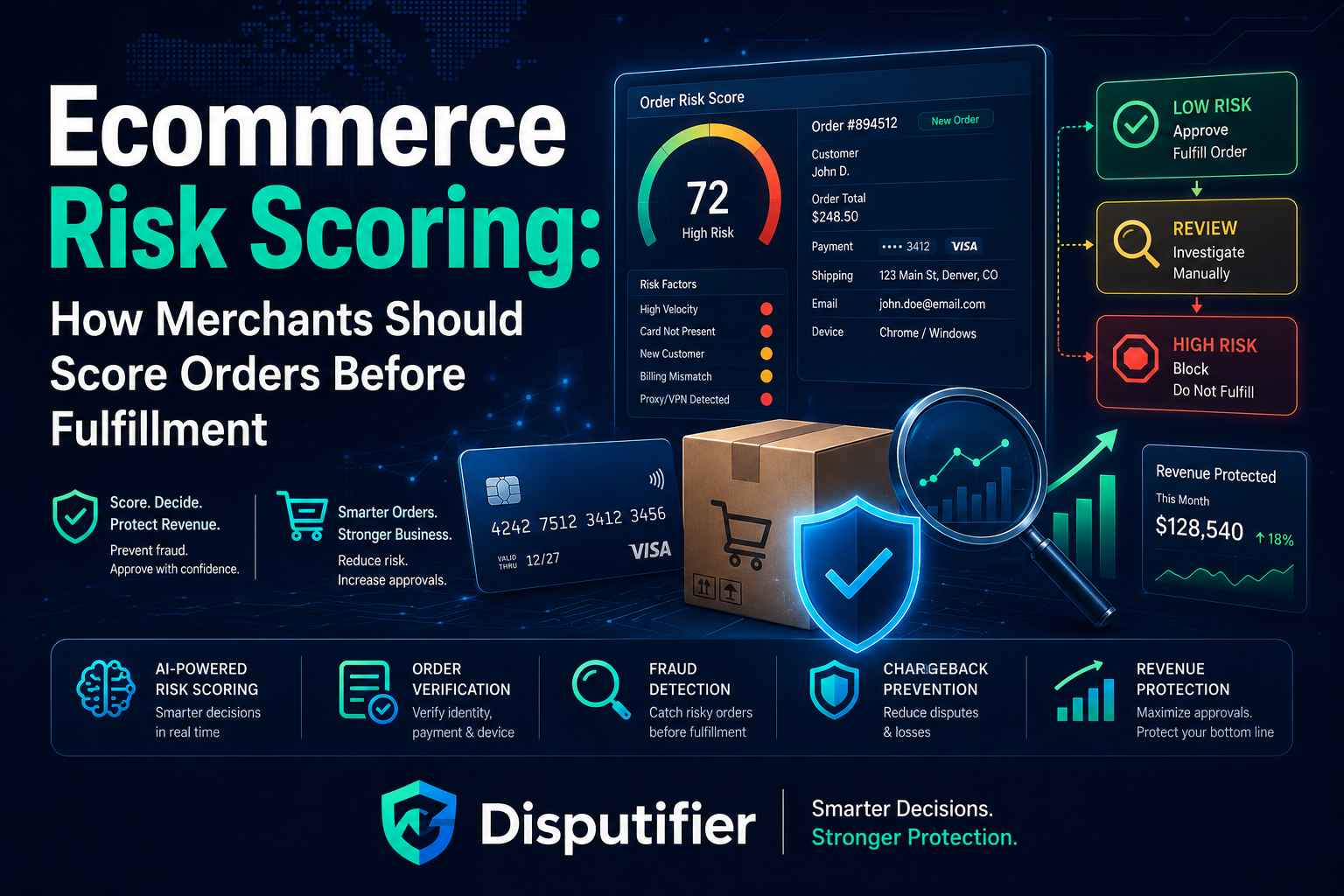
Ecommerce risk scoring gives merchants a structured way to evaluate orders before fulfillment. Instead of relying on gut instinct or blanket rules, a risk scoring system weighs multiple signals across each transaction and assigns a score that tells you whether to approve, review, or reject an order.
Done right, ecommerce risk scoring catches fraud early, reduces chargebacks, and protects your merchant account - without blocking legitimate customers.
What Ecommerce Risk Scoring Actually Is
Risk scoring is the process of evaluating a transaction against a set of signals - card data, behavioral patterns, device fingerprints, shipping details, order history, and more - and producing a composite score that reflects the likelihood of fraud or dispute.
A low score means the order looks clean. A high score means something doesn't add up. Everything in between is a judgment call - and a good risk scoring system helps you make that call faster and more consistently.
Ecommerce fraud detection works the same way at a broader level, but risk scoring applies that logic at the individual order level, before fulfillment. That timing is what makes it so powerful.
The Signals That Feed a Risk Score
No single signal tells the whole story. Ecommerce risk scoring works because it combines multiple data points into a single picture. Here are the most important ones.
Card and BIN Data
The Bank Identification Number (BIN) - the first six to eight digits of a card number - tells you a lot about a transaction before it processes. It identifies the issuing bank, card type, card level, and the country where the card was issued.
When the BIN data doesn't match the shipping address, billing address, or IP location, that mismatch is a meaningful fraud signal. How BIN data helps detect fraud before it happens covers this in detail - BIN intelligence is one of the fastest, most accessible risk signals available to ecommerce merchants.
You can validate BIN data instantly with Disputifier's free BIN checker at the point of transaction.
AVS and CVV Verification
Address Verification Service (AVS) checks whether the billing address a customer enters matches what's on file with their card issuer. CVV checks verify the card security code.
Mismatches on either signal don't automatically mean fraud, but they raise the risk score. AVS and CVV mismatches require context - a shipping address that differs from billing is normal for gift purchases, but an AVS failure paired with an international IP and a high-value order is a different story.
Velocity and Order Patterns
Multiple orders placed in quick succession from the same IP, email domain, or device - especially using different card numbers - are a strong indicator of card testing or BIN testing activity. What is card testing and how to stop it explains how fraudsters use small transactions to validate stolen cards before making larger purchases.
Velocity checks should be a core component of any risk scoring system. Unusual order frequency is one of the clearest behavioral fraud signals in ecommerce.
IP and Device Signals
High-risk IP addresses - proxies, VPNs, Tor exit nodes - are commonly used by fraudsters to mask their location. Device fingerprinting adds another layer, identifying whether the same device has been linked to prior chargebacks or suspicious activity.
When IP location, billing country, and card issuing country all diverge, the risk score should reflect it.
Order Characteristics
High-value orders, orders with expedited shipping to new addresses, and orders where multiple high-demand items are purchased in one transaction all carry elevated risk. Digital goods and gift cards are especially high-risk categories because they're non-refundable and immediately transferable.
Your risk scoring model should apply higher weighting to these order types automatically.
How Risk Scoring Connects to Chargeback Prevention
Ecommerce risk scoring isn't just about stopping fraud at checkout. It directly impacts your chargeback rate - and your chargeback rate directly impacts your merchant account health.
Chargeback risk scoring is how processors evaluate merchants too. If your dispute ratio climbs past threshold, you enter monitoring programs that come with fees, restrictions, and the threat of account termination. The orders that generate chargebacks are often the same orders that would have flagged under a proper risk scoring system.
Catching those orders before fulfillment means fewer disputes filed. Fewer disputes mean a lower chargeback ratio. A lower ratio keeps your processing relationship intact.
Building a Risk Scoring Framework for Your Store
You don't need enterprise infrastructure to implement ecommerce risk scoring. Here's a practical framework.
Start by identifying your highest-risk order characteristics based on your own historical data. Look at which orders resulted in chargebacks or confirmed fraud - what did they have in common? High-value carts? International shipping addresses? Mismatched BIN data? New customer accounts with no order history?
Next, assign weighted scores to each signal. Not all signals carry equal weight. A billing-shipping address mismatch alone is low risk. That same mismatch combined with a high-risk BIN, an international IP, and expedited shipping on a new account is high risk. The combination is what matters.
Then set thresholds for action. Orders below a certain score auto-approve. Orders above a certain score auto-reject or flag for manual review. Everything in between gets a second look from your team.
Finally, revisit and refine your model regularly. Fraud patterns evolve. The signals that predicted fraud six months ago may not capture new attack vectors today. Your scoring model should improve continuously based on outcomes.
Why Manual Review Alone Isn't Enough
Some merchants skip scoring and rely on their team to flag suspicious orders manually. This works at very low volume - it fails at scale.
Manual review is slow, inconsistent, and expensive. Different team members apply different standards. High-volume periods mean more orders get waved through without proper scrutiny. And fraudsters know this - they often place orders during peak periods precisely because they expect review capacity to be strained.
Ecommerce fraud prevention at scale requires automation. Risk scoring is what makes that automation possible - it gives your team a clear signal on which orders need attention and which can move straight to fulfillment.
How Disputifier Strengthens Your Risk Scoring System
Disputifier is ecommerce fraud prevention and chargeback management software built specifically for online merchants. It integrates BIN intelligence, real-time fraud signals, and automated dispute workflows into a single platform - giving merchants the tools to catch risk before it becomes a chargeback and respond automatically when it does.
Disputifier's free BIN checker validates card data at the point of transaction, surfacing issuer country, card type, and risk signals instantly. That BIN intelligence feeds directly into your risk evaluation before an order ships.
Beyond pre-fulfillment screening, Disputifier monitors for dispute activity in real time. When a chargeback is filed, Disputifier detects it immediately and triggers an automated evidence-building workflow - pulling transaction data, order records, and customer communication to build the strongest possible response.
Its machine learning models improve over time based on your specific dispute patterns, which means the platform gets more accurate the longer you use it. Disputifier also integrates with chargeback alert networks, giving merchants the window to resolve disputes before they're formally filed.
For Shopify merchants, Disputifier connects directly to your store - pulling order data, fulfillment records, and communication logs automatically so nothing is missed.
If you're scoring orders manually or relying on basic platform fraud filters, Disputifier gives you a significantly stronger layer of protection. Start using Disputifier to catch fraud before it ships.
Frequently Asked Questions
**What is ecommerce risk scoring?**Ecommerce risk scoring is a method of evaluating individual orders against multiple fraud signals - card data, behavioral patterns, IP location, BIN data, and more - to determine the likelihood of fraud or chargeback before fulfillment.
**What signals should my risk score include?**At minimum: BIN data, AVS and CVV verification results, IP and device signals, velocity checks, and order characteristics like value, product type, and shipping speed. The strongest models combine all of these into a weighted composite score.
**How does risk scoring reduce chargebacks?**High-risk orders are statistically more likely to result in chargebacks. By flagging or blocking those orders before fulfillment, you eliminate the root cause - rather than dealing with the dispute after the fact.
**Can small ecommerce stores implement risk scoring?**Yes. You don't need enterprise infrastructure. Starting with BIN validation, AVS/CVV checks, and velocity monitoring gives most small-to-mid-size stores meaningful fraud coverage. Tools like Disputifier make this accessible without building custom systems.
**How does BIN data improve risk scoring?**BIN data identifies the issuing bank, card type, and country of origin. When that information conflicts with billing address, shipping address, or IP location, it signals elevated fraud risk. How BIN data helps detect fraud before it happens covers this in detail.
**What's the difference between fraud prevention and chargeback prevention?**Fraud prevention focuses on stopping bad transactions before they occur. Chargeback prevention includes that - plus dispute response, alert management, and keeping your chargeback ratio low enough to protect your merchant account. Disputifier covers both.
Score Orders Smarter - and Stop Chargebacks Before They Start
Ecommerce risk scoring is one of the highest-leverage changes a merchant can make to their fraud prevention stack. It shifts your defense to the front of the transaction - before fulfillment, before disputes, before the damage is done.
Disputifier gives you the BIN intelligence, real-time fraud signals, and automated chargeback management to make that shift happen. Stop letting risky orders slip through and start protecting your store with a system built for ecommerce merchants. Get started with Disputifier today.