 All Posts


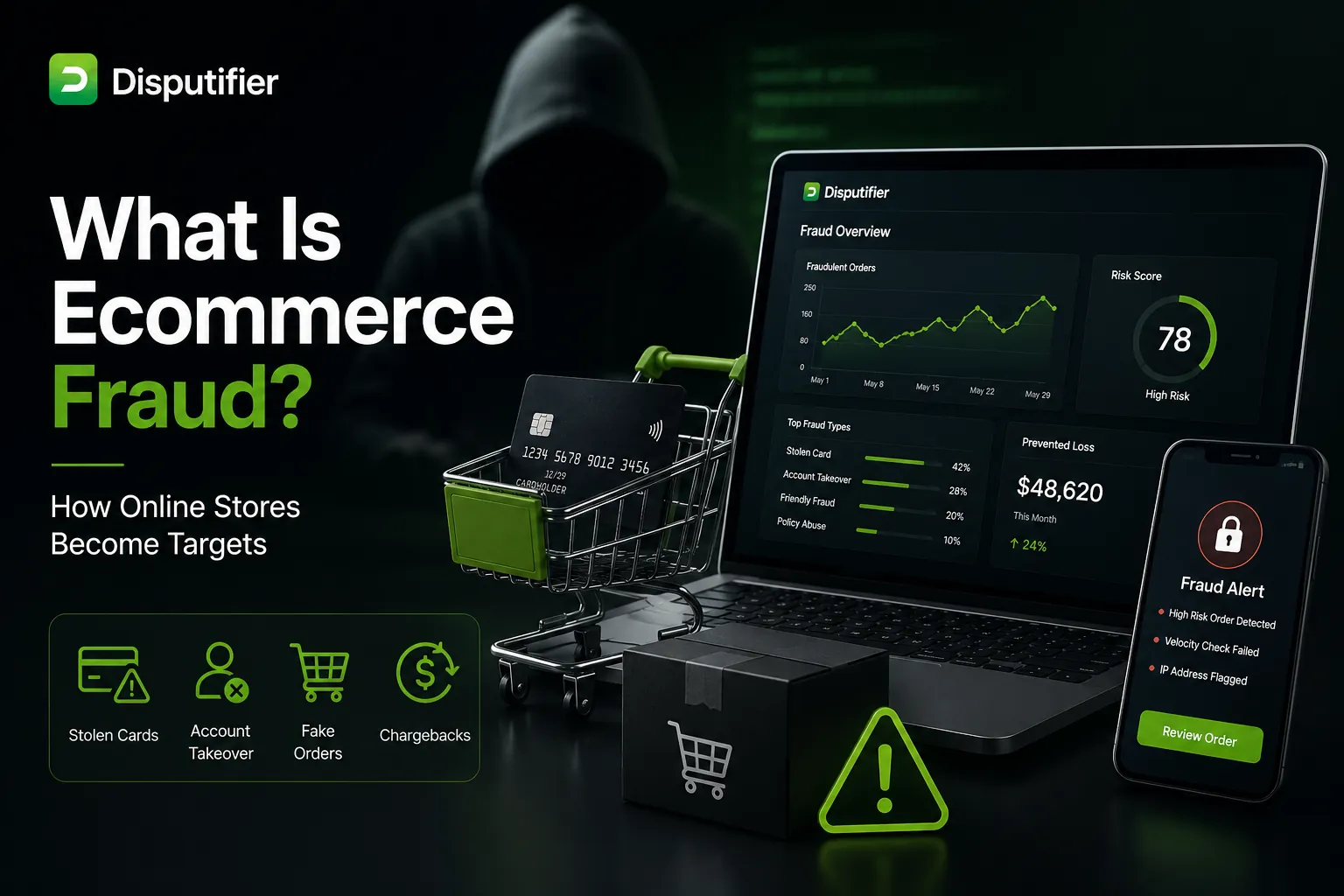
Every online store is a fraud target. It doesn't matter what you sell, how long you've been operating, or how carefully you review orders. If you accept card payments online, fraudsters are looking for ways to exploit that.
Ecommerce fraud costs merchants far more than the transaction value. There's the lost product, the fulfillment cost, the chargeback fee, and the ratio damage that compounds over time. Understanding what ecommerce fraud is, how it works, and what makes online stores vulnerable is the first step to protecting your revenue.
What Is Ecommerce Fraud?
Ecommerce fraud is any deceptive or unauthorized activity that results in financial loss for an online merchant. It covers a wide range of attacks - from stolen card usage to deliberate dispute abuse - but all share the same outcome: the merchant absorbs a loss they didn't cause.
The most important thing to understand about ecommerce fraud is that most of it doesn't look like fraud when it happens. A fraudulent order looks like a normal order. A stolen card transaction looks like a real customer purchase. By the time the fraud becomes visible - through a chargeback, a reversal, or a flagged account - the product has already shipped and the money has already moved.
This is what makes ecommerce fraud so damaging. The loss is locked in before most merchants even realize they've been targeted.
The Main Types of Ecommerce Fraud
Not all ecommerce fraud works the same way. The most common types have distinct patterns, and defending against them requires understanding how each one operates.
True Fraud (Stolen Card Fraud)
True fraud is what most people picture when they hear "fraud" - someone using a stolen credit or debit card to make purchases online without the cardholder's knowledge.
The fraudster obtains card data through data breaches, phishing attacks, or dark web purchases. They then use that data to place orders - often for high-value goods, digital products, or items that are easy to resell. The real cardholder eventually notices the unauthorized charge and disputes it. The merchant loses the product, the funds, and pays a chargeback fee.
True fraud is hard to spot at the transaction level because the card data is real - it's just being used by the wrong person. Detection requires signals like BIN mismatches, IP conflicts, velocity anomalies, and AVS failures. Ecommerce fraud detection: how to identify fraud before it costs you covers the full signal set in detail.
Friendly Fraud (First-Party Fraud)
Friendly fraud is the most prevalent type of ecommerce fraud by volume - and the hardest to see coming. It happens when a legitimate customer, using their own card, disputes a valid transaction after receiving the product or service.
The customer might claim the item never arrived, that they didn't authorize the purchase, or that the product wasn't as described. The bank reverses the transaction. The merchant loses the revenue and the product.
Friendly fraud is particularly damaging because there's nothing fraudulent about the original transaction. The card is real. The customer is real. The order looked clean at checkout. The fraud only becomes visible when the chargeback arrives weeks later.
What is friendly fraud and how it leads to chargebacks covers the mechanics in full. Understanding the root causes - buyer's remorse, subscription confusion, unrecognized charges, and deliberate abuse - is what makes prevention possible.
Card Testing and BIN Testing
Card testing is a high-volume attack pattern where fraudsters run small test transactions - often $1 or less - to validate whether stolen card numbers are active before using them for larger purchases.
BIN testing is a related pattern where fraudsters test entire ranges of card numbers against a specific BIN (Bank Identification Number) to identify which cards in that range are live.
Both attacks generate real chargebacks from the real cardholders. What is card testing and how to stop it covers the attack mechanics - the tell-tale pattern is a spike in micro-transactions from the same IP address, device, or card range in a short window.
Refund Abuse
Refund abuse is a less visible but equally costly type of ecommerce fraud. A customer exploits your return or refund policies to get money back on goods they've kept, used, or never intended to return.
Common patterns include claiming an item was never received when it was, returning a different item than the one purchased, or filing a return after exceeding the return window. How to prevent refund abuse in ecommerce covers the specific behaviors to watch for and how to shut them down operationally.
Account Takeover Fraud
Account takeover fraud happens when a fraudster gains access to a legitimate customer's account - through credential stuffing, phishing, or data breach exposure - and uses the stored payment information and shipping addresses to place fraudulent orders. The real account holder eventually disputes the charges, and the merchant absorbs the losses.
Why Online Stores Are Such Attractive Fraud Targets
Ecommerce has structural characteristics that make fraud easier than in physical retail.
There's no face-to-face verification. A fraudster placing an order online never has to present a card or identification in person. The entire transaction happens through data entry - and stolen data is indistinguishable from real data at the input level.
The chargeback system defaults in favor of the cardholder. When a customer disputes a charge, banks typically reverse the transaction first and ask questions later. The burden of proof sits entirely with the merchant - who has to prove the transaction was legitimate while the funds are already gone.
Fulfillment happens before disputes are filed. A fraudulent order ships based on a transaction that looks clean at checkout. The chargeback arrives 60 to 90 days later, by which point the product is unrecoverable.
Platform fraud tools have coverage gaps. Shopify, WooCommerce, and most payment processors provide basic fraud indicators - but they don't validate BIN data, don't integrate with pre-dispute alert networks, and don't learn from your store's specific fraud history. Ecommerce fraud prevention: why merchants are losing revenue without the right tools covers exactly where these gaps live and why they matter.
What Ecommerce Fraud Actually Costs Merchants
The direct cost of an ecommerce fraud event is larger than the transaction value. The typical loss structure includes the product cost, the shipping and fulfillment cost, the payment processing fee on the original transaction, and a chargeback fee when the dispute is filed.
But the indirect costs are often more significant. Every chargeback - regardless of cause - counts against your chargeback ratio. Enough of them and you enter a processor monitoring program, which brings monthly fees, processing restrictions, and a narrow window to remediate before account termination. Chargeback monitoring programs covers what happens when a merchant's ratio crosses threshold - the consequences compound quickly.
Rolling reserves add another layer. When processors become concerned about a merchant's chargeback rate, they hold a percentage of revenue as protection. This cash flow impact hits while the merchant is already absorbing fraud losses.
The Warning Signs That Your Store Is Being Targeted
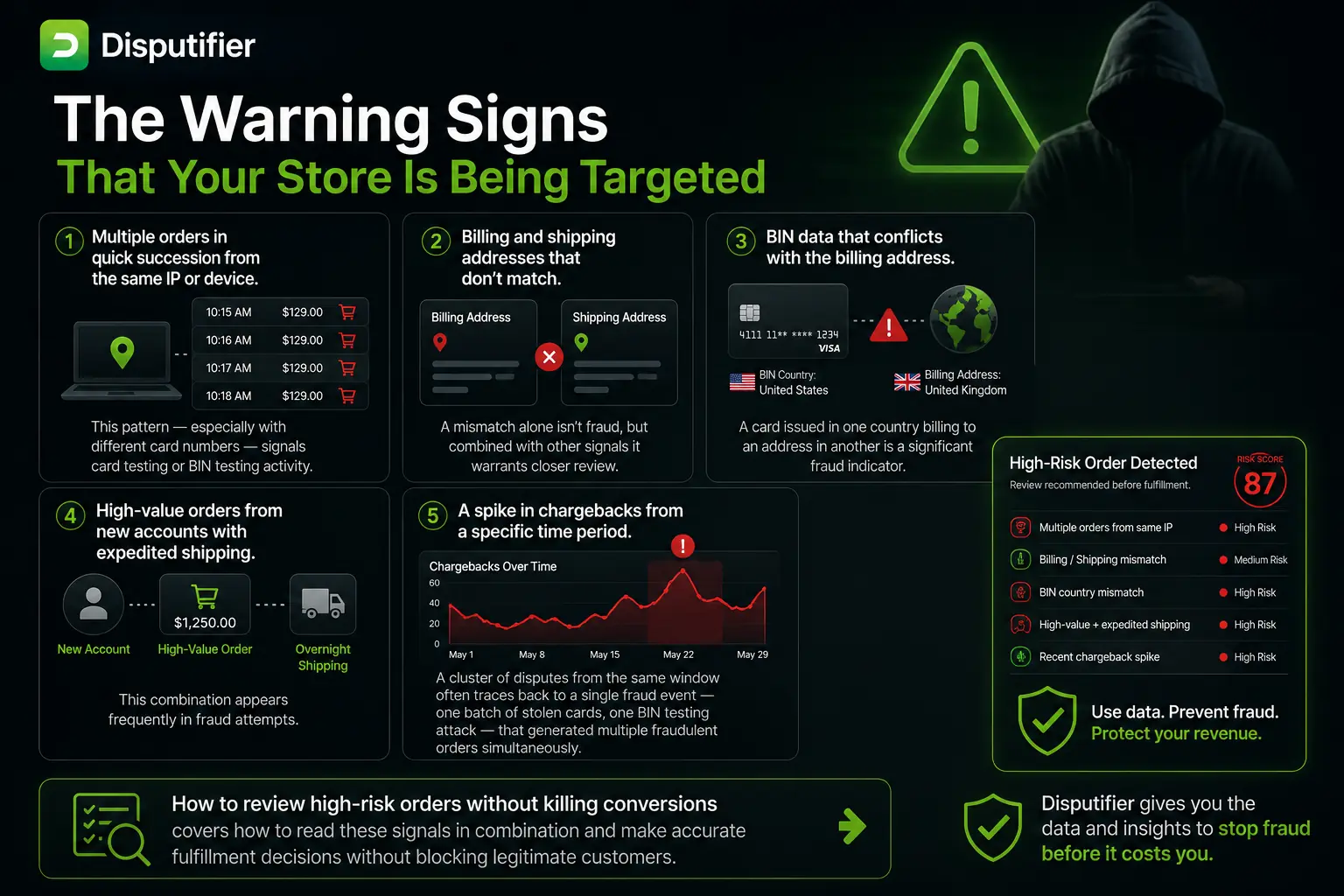
Knowing what ecommerce fraud looks like in practice helps merchants catch it early.
Multiple orders in quick succession from the same IP or device. This pattern - especially with different card numbers - signals card testing or BIN testing activity.
Billing and shipping addresses that don't match. A mismatch alone isn't fraud, but combined with other signals it warrants closer review.
BIN data that conflicts with the billing address. A card issued in one country billing to an address in another is a significant fraud indicator. Disputifier's free BIN checker validates card country of origin instantly - giving merchants real fraud intelligence before making a fulfillment decision.
High-value orders from new accounts with expedited shipping. This combination appears frequently in fraud attempts - large orders that need to move quickly before the fraud is detected.
A spike in chargebacks from a specific time period. A cluster of disputes from the same window often traces back to a single fraud event - one batch of stolen cards, one BIN testing attack - that generated multiple fraudulent orders simultaneously.
How to review high-risk orders without killing conversions covers how to read these signals in combination and make accurate fulfillment decisions without blocking legitimate customers.
How Disputifier Protects Ecommerce Merchants from Fraud
Disputifier is ecommerce fraud prevention and chargeback management software built specifically for online merchants. It addresses every stage of the fraud problem - detection before fulfillment, alert management before disputes are filed, and automated response when chargebacks land.
Real-time BIN intelligence. Disputifier validates card BIN data automatically on every order - flagging issuer country mismatches, prepaid card activity, and card type anomalies before fulfillment decisions are made. The free BIN checker gives merchants immediate access to card-level fraud intelligence at no cost.
Fraud signal monitoring. Disputifier monitors velocity patterns, IP classification, device fingerprints, and order characteristics in real time - building a per-order risk picture that surfaces fraud signals platform-native tools miss.
Chargeback alert integration. Disputifier connects to Ethoca and Verifi alert networks automatically. When a potential dispute is flagged before it's formally filed, Disputifier processes the alert - giving merchants the opportunity to resolve it as a refund before it becomes a chargeback. An alert resolved this way never hits your ratio.
Real-time chargeback detection and automated response. When fraud does generate a chargeback, Disputifier detects it immediately and builds an automated evidence package - order records, delivery confirmation, customer communication - submitted before the deadline closes. Every dispute gets a complete, timely response without manual input.
Machine learning that learns your fraud patterns. Disputifier's models improve based on your specific dispute outcomes - identifying which order types, card characteristics, and customer behaviors generate fraud on your store specifically. The platform gets more accurate over time. Chargeback fraud prevention: how AI and automation are changing the game covers why this adaptive intelligence matters at scale.
Root cause analytics. Disputifier surfaces your fraud patterns by type, product category, and customer segment - so you can fix the operational gaps enabling fraud, not just respond to individual incidents.
For Shopify merchants, Disputifier integrates directly with your store, pulling order data and customer communication automatically so every layer of fraud protection operates without manual overhead.
Ecommerce fraud doesn't announce itself. Disputifier catches it before it costs you. Start protecting your store with Disputifier today.
Frequently Asked Questions
What is ecommerce fraud?
Ecommerce fraud is any deceptive or unauthorized activity that results in financial loss for an online merchant. It includes stolen card usage, friendly fraud, card testing, refund abuse, and account takeover - all of which generate losses that merchants absorb directly.
What are the most common types of ecommerce fraud?
The most common types are true fraud (stolen card usage), friendly fraud (legitimate cardholders disputing valid purchases), card testing and BIN testing (fraudsters validating stolen card data), and refund abuse (customers exploiting return policies).
Why is ecommerce fraud so hard to detect?
Most ecommerce fraud looks like a legitimate transaction at the point of purchase. Stolen card data is real data. Friendly fraud comes from real customers. The fraud only becomes visible through a chargeback that arrives 60 to 90 days later - after the product has already shipped.
What does ecommerce fraud cost merchants?
The direct cost includes the product, fulfillment, processing fee, and chargeback fee. The indirect costs - ratio damage, processor monitoring programs, rolling reserves - often exceed the direct transaction losses.
How can I tell if my store is being targeted by fraud?
Key warning signs include velocity spikes from the same IP or device, BIN data that conflicts with billing addresses, high-value orders from new accounts with expedited shipping, and clusters of chargebacks from a specific time period.
What is the difference between true fraud and friendly fraud?
True fraud involves someone using a stolen card without the cardholder's knowledge. Friendly fraud involves the real cardholder disputing a legitimate purchase. Both result in chargebacks, but they require different detection and prevention approaches.
How does BIN intelligence help detect ecommerce fraud?
BIN data identifies the issuing bank, card type, and country of origin of every card used in your store. When that data conflicts with a customer's billing address or IP location, it signals fraud risk before fulfillment - when you can still act. Disputifier's free BIN checker validates this instantly.
How does Disputifier protect against ecommerce fraud?
Disputifier combines real-time BIN intelligence, automated chargeback alert resolution, machine learning fraud detection, and automated dispute response into a single platform - covering every stage from pre-transaction fraud screening to post-chargeback evidence submission.
Understand Ecommerce Fraud - Then Build the System That Stops It
Ecommerce fraud is sophisticated, widespread, and costs merchants far more than most realize. The stores that manage it successfully aren't the ones who got lucky - they're the ones who built a fraud prevention system that operates at every stage of the transaction lifecycle.
Disputifier gives online merchants the BIN intelligence, real-time fraud monitoring, alert management, and automated dispute response to catch fraud before it ships and win the disputes that get through. Get started with Disputifier today.