 All Posts


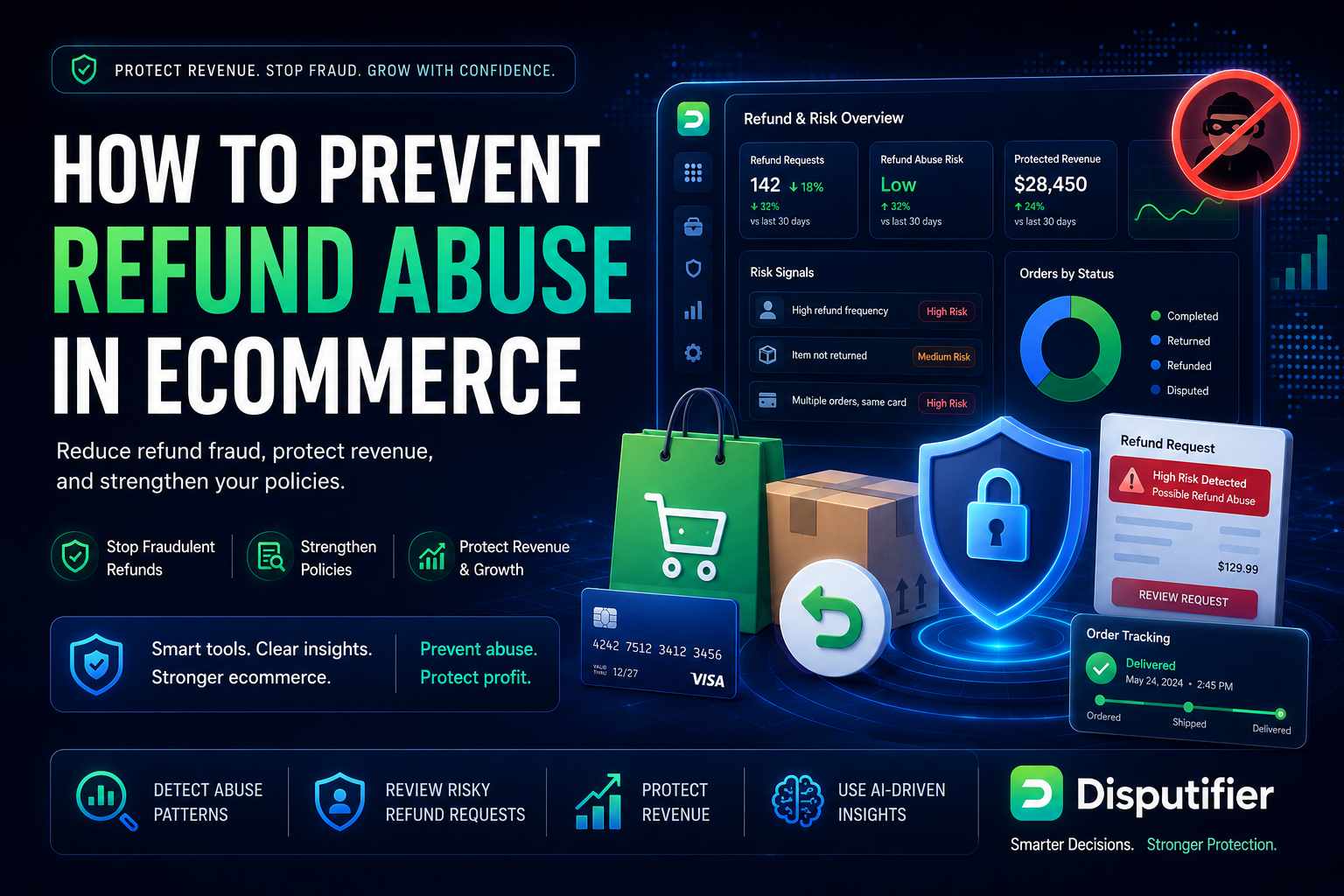
Refund abuse in ecommerce is one of the easiest ways for revenue to leak without getting enough attention.
A lot of merchants focus heavily on chargebacks, fraud screening, and shipping issues, but refund abuse often sits in the background quietly eating margin. It can look like normal customer service at first. A customer requests a refund. Another claims an item never arrived. Another says the product was damaged, used once, and returned. Another keeps ordering and returning in a pattern that clearly is not normal.
Individually, these cases may seem manageable.
Collectively, they can become expensive.
That is why refund abuse ecommerce merchants face should be treated as a real loss-prevention problem, not just a support inconvenience.
This guide explains what refund abuse is, the most common forms it takes, why it matters, how to prevent it, and how Disputifier helps ecommerce brands connect refund abuse, fraud signals, and chargeback prevention into one smarter system.
If you want the broader foundation first, read Ecommerce Fraud Prevention: Complete Guide for Online Stores.
What is refund abuse in ecommerce?
Refund abuse in ecommerce happens when a customer takes advantage of a store’s refund, return, replacement, or customer-service policies in a way that creates unfair loss for the merchant.
Sometimes that abuse is deliberate.
Sometimes it sits in a gray area between customer behavior and fraud.
Either way, the result is the same: the merchant absorbs avoidable cost.
Refund abuse can include:
- falsely claiming an order never arrived
- returning used or damaged products as if they were unused
- claiming an item was defective when it was not
- demanding both a refund and a replacement
- repeatedly exploiting generous return windows
- using friendly fraud when a refund is denied
- abusing subscription or recurring-billing refund policies
That is what makes it important.
Refund abuse is not always a chargeback. But it often lives right next to chargeback risk.
Why refund abuse matters
Refund abuse matters because it cuts into revenue from several directions at once.
It can cost merchants:
- product value
- shipping expenses
- reverse logistics costs
- support labor
- replacement costs
- restocking losses
- margin erosion
- future dispute risk
And when refund abuse is handled poorly, it can turn into even more expensive problems like chargebacks, higher dispute volume, and weaker customer-service workflows.
That is why refund abuse belongs in the same conversation as fraud prevention and chargeback prevention.
If you want the broader loss-protection angle, read Chargeback Protection for Merchants: How It Works and What Actually Helps.
Common types of refund abuse in ecommerce
Refund abuse is not one behavior. It shows up in several patterns.
False item-not-received claims
A customer says the package never arrived, even though tracking or delivery records suggest otherwise.
This often overlaps with shipping-proof problems and can become a chargeback if the merchant cannot defend the order well.
Wardrobing or temporary use
The customer buys a product, uses it briefly, then returns it for a refund as if it were unused.
This is common with apparel, electronics, tools, event-driven products, and seasonal purchases.
Empty-box or wrong-item returns
The customer sends back something different, incomplete, or worthless while claiming it is the original item.
Repeated serial refunding
A customer repeatedly requests refunds across multiple orders in a pattern that clearly goes beyond normal support needs.
Refund plus replacement abuse
The customer obtains a refund, replacement, or store credit while keeping the original product too.
Refund threat behavior
Some customers threaten chargebacks or negative outcomes unless the merchant issues a refund outside normal policy.
That is where refund abuse starts overlapping directly with friendly fraud.
Refund abuse vs chargeback fraud
These two issues are connected, but they are not identical.
Refund abuse usually starts inside the merchant’s own customer-service process. The customer asks the merchant for money back, a replacement, or a concession.
Chargeback fraud usually escalates through the bank.
The reason this distinction matters is simple: many refund abuse cases become chargeback cases later.
A customer who fails to get the refund they want may go straight to the bank next. That is why merchants need to manage refund abuse carefully. If the process is too loose, they lose money. If the process is too rigid or messy, they may trigger more disputes.
For more on that overlap, read How to Prevent Chargeback Fraud in Ecommerce.
Why ecommerce stores are vulnerable to refund abuse
Ecommerce makes refund abuse easier because merchants are selling at a distance.
They cannot inspect customer intent in person. They depend on shipping records, product photos, order history, support logs, and policy enforcement.
That creates gaps.
The biggest vulnerabilities usually include:
- weak return policy enforcement
- poor documentation
- inconsistent customer-service handling
- weak delivery proof
- slow internal escalation
- lack of customer behavior tracking
- no visibility into repeat abuse patterns
This is where many merchants get stuck. They treat every refund request as an isolated support case instead of part of a broader risk pattern.
How to prevent refund abuse in ecommerce
Preventing refund abuse requires balance.
You do not want a return policy so strict that it destroys trust and conversions. But you also do not want a policy so loose that it invites manipulation.
Here is what actually helps.
Create a clear return and refund policy
Your policy should be easy to understand and easy to enforce.
That means being clear about:
- refund windows
- return conditions
- damaged item requirements
- replacement rules
- non-returnable items
- shipping responsibilities
- documentation requirements
Ambiguity creates room for abuse.
Clarity reduces friction and gives your team a firmer foundation when disputes happen.
Track customer behavior over time
One refund request may be normal.
Five refund requests across multiple orders may not be.
Merchants should look for patterns like:
- repeat “item not received” claims
- repeated damage claims
- frequent replacement demands
- abnormal return rates
- repeated order-refund cycles
- support behavior tied to past disputes
This is one reason analytics matter so much. Abuse is often clearer as a pattern than as a single case.
Strengthen delivery proof
A lot of refund abuse starts with weak shipment evidence.
Use:
- tracking on every order
- delivery confirmation
- signature confirmation for high-value shipments
- shipment updates
- carrier-status records
Better proof reduces false delivery claims and supports stronger case handling if the customer escalates later.
Document customer communication carefully
This matters more than merchants think.
If a customer claims one thing in the refund request, another thing in support chat, and then escalates differently later, that record matters.
Clear communication logs help merchants:
- identify inconsistent claims
- defend valid orders
- spot repeat abuse patterns
- prepare stronger evidence if a dispute appears
For more on that, read Customer Communication Proof That Actually Wins Disputes.
Build a review path for suspicious refund requests
Not every refund request should be approved automatically.
Merchants should create a manual review step for suspicious cases, especially when they involve:
- high-value orders
- repeat customers with bad history
- mismatched claims
- vague evidence
- unusual urgency
- overlap with known fraud signals
This is where support and fraud prevention need to work together.
Connect refund abuse to fraud screening
Refund abuse is often treated as a post-purchase issue only.
That is too narrow.
Some abusive behavior starts with risky orders in the first place. Fraud screening signals like device behavior, BIN data, order velocity, and customer history can help merchants identify transactions that deserve closer attention later.
That is one reason Disputifier’s free BIN checker is useful. It adds payment-level context that helps merchants build a stronger review framework around suspicious transactions and future abuse risk.
Prepare for escalation into disputes
Refund abuse can turn into chargebacks when a merchant denies a questionable request and the customer goes to the bank instead.
That is why prevention should also include evidence readiness.
You should already be able to access:
- order records
- tracking data
- refund policy acceptance
- support logs
- return-condition records
- photos where relevant
- transaction details
If the case escalates, that groundwork matters.
If you want the response side, read How to Win a Chargeback: Step-by-Step for Ecommerce.
Where merchants get refund abuse wrong
There are a few common mistakes.
They approve too much too quickly
This trains abusive customers to keep pushing.
They deny requests without good documentation
That increases the odds of escalation and future disputes.
They treat each case in isolation
That hides repeat behavior and serial abuse.
They separate support from fraud prevention
That creates blind spots between customer-service issues and real risk patterns.
They never review refund patterns analytically
Without analytics, the same losses repeat.
Why Disputifier matters for refund abuse prevention
Disputifier matters because refund abuse is not just a support problem.
It sits at the intersection of fraud prevention, customer behavior, dispute risk, and operational decision-making.
That is exactly where most merchants need more help.
Disputifier helps merchants identify abuse patterns
Abuse is easier to spot when merchants can see the broader history around customer behavior, order risk, and dispute outcomes.
Disputifier helps merchants move beyond isolated case handling and into pattern recognition.
Disputifier helps merchants connect refund behavior to chargeback risk
This is a big one.
A questionable refund request is not always just a refund request. Sometimes it is an early signal that the case may become a chargeback later.
Disputifier helps merchants connect those dots faster.
Disputifier helps merchants improve evidence readiness
If an abusive refund request escalates, the merchant needs organized records. Disputifier helps merchants tighten workflows around the information that matters most.
Disputifier helps merchants protect revenue without guessing
The goal is not to deny more refunds blindly.
The goal is to identify which situations deserve approval, which deserve review, and which reflect real abuse risk.
That is where better systems beat gut instinct.
A practical refund abuse prevention checklist
If you want the short version, focus on these steps:
1. Write a clear refund and return policy
Make it easy to understand and enforce.
2. Track repeat refund behavior
Patterns matter more than isolated cases.
3. Strengthen shipping and delivery proof
This reduces false non-delivery claims.
4. Keep support documentation clean
Good records help both prevention and escalation defense.
5. Review suspicious requests manually
Do not auto-approve every edge case.
6. Connect refund abuse to fraud signals
The order risk often matters before the refund request arrives.
7. Prepare for dispute escalation
Some refund abuse becomes chargeback abuse next.
Build a smarter refund abuse prevention system
If you want to prevent refund abuse in ecommerce, the answer is not harsh policies or blind generosity.
It is a better system.
That system should help you identify risky customer behavior, document claims clearly, connect refunds to fraud and dispute signals, and protect revenue without damaging legitimate customer trust.
That is why Disputifier is so useful here.
It helps ecommerce merchants connect fraud prevention, customer behavior, payment intelligence, and dispute workflows into a stronger loss-prevention strategy.
Start by tightening your review process, documenting customer behavior more clearly, and using Disputifier’s free BIN checker to add stronger payment-level context where suspicious transaction patterns exist.
Refund abuse may start as a support issue, but it becomes a much bigger business problem when merchants fail to see the pattern.
Frequently Asked Questions
What is refund abuse in ecommerce?
Refund abuse in ecommerce happens when customers exploit refund, return, replacement, or customer-service policies in ways that create unfair financial loss for the merchant.
Is refund abuse the same as chargeback fraud?
No. Refund abuse usually begins inside the merchant’s own support process, while chargeback fraud escalates through the bank. But the two often overlap.
How can merchants prevent refund abuse?
Merchants can prevent refund abuse by using clear policies, tracking repeat behavior, improving delivery proof, documenting support communication, and reviewing suspicious requests more carefully.
Why does refund abuse matter so much?
It matters because it drains margin, increases support workload, creates repeat losses, and can escalate into chargebacks if handled poorly.
Why is Disputifier useful for refund abuse prevention?
Disputifier helps merchants connect customer behavior, fraud signals, refund patterns, and dispute risk into a stronger operational system for loss prevention.