 All Posts


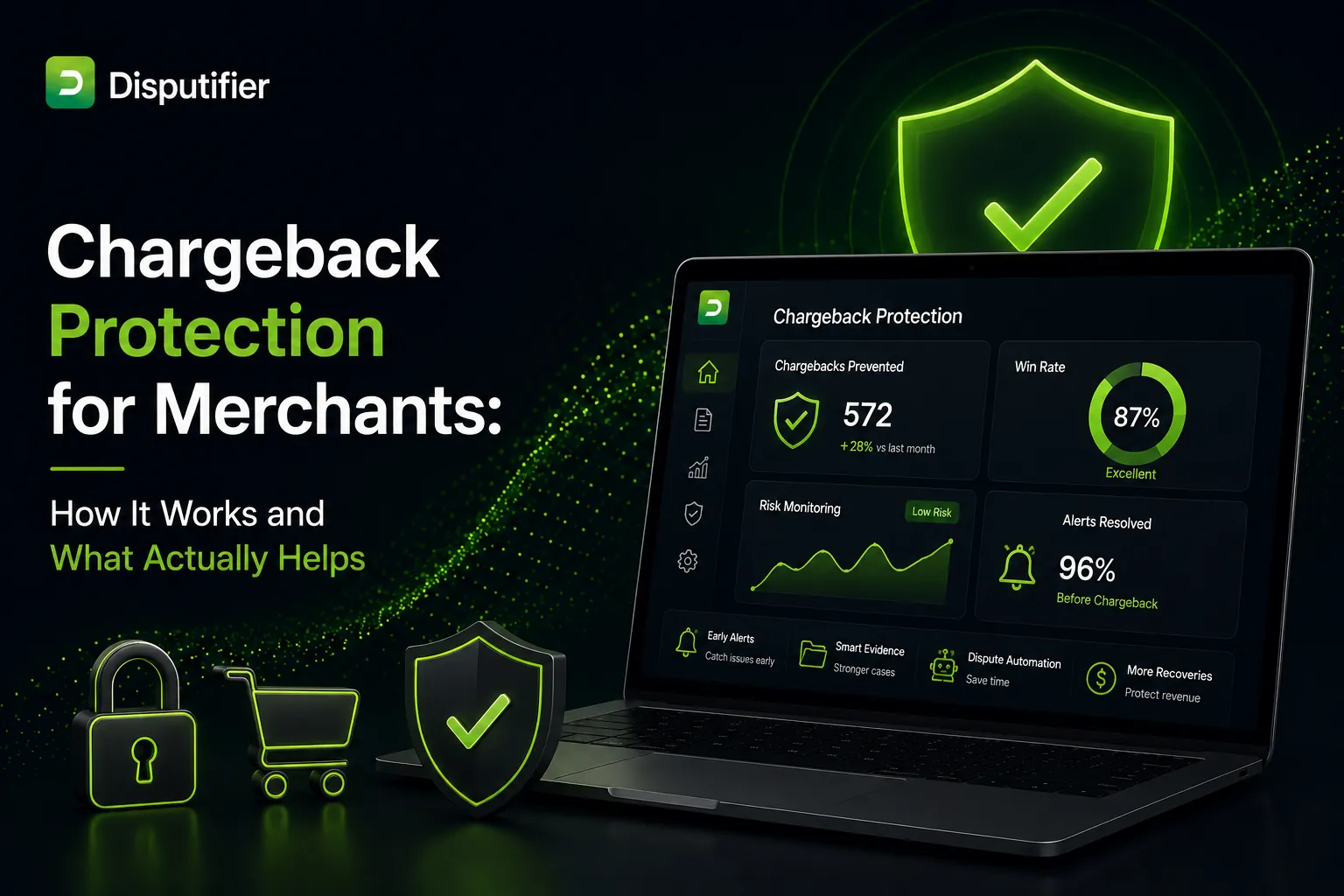
Chargeback protection for merchants is not just about fighting disputes after they happen.
That is the mistake a lot of ecommerce brands make.
They think chargeback protection starts when the bank notifies them about a dispute. By then, the sale is already at risk, the response deadline is already ticking, and the merchant is already playing defense.
Real chargeback protection starts much earlier.
It begins with fraud prevention, better transaction screening, stronger customer communication, smarter alerts, organized evidence, and analytics that help you spot patterns before they become expensive. If you only react after the chargeback arrives, your protection strategy is incomplete.
This guide breaks down how chargeback protection works, what actually helps ecommerce merchants, where manual workflows fail, and why a platform like Disputifier matters if you want to protect revenue at scale.
If you need the broader foundation first, start with What Is a Chargeback? The Complete Ecommerce Guide.
What is chargeback protection for merchants?
Chargeback protection for merchants is the combination of tools, processes, and systems that reduce chargeback risk and improve the merchant’s ability to recover revenue when disputes happen.
That includes two core goals:
- preventing chargebacks before they happen
- responding effectively when they still happen
A lot of people talk about chargeback protection as if it is one product or one setting.
It is not.
Good chargeback protection is layered. It usually includes:
- fraud prevention
- transaction screening
- alert tools
- customer communication systems
- delivery and fulfillment proof
- evidence management
- dispute workflows
- analytics and reporting
The strongest ecommerce merchants do not treat chargeback protection as one isolated feature. They treat it as part of revenue protection.
Why merchants need chargeback protection
Chargebacks hurt more than most merchants realize.
When a chargeback hits, you may lose:
- the original sale
- the product
- shipping costs
- processing time
- support labor
- dispute response labor
- chargeback fees
And if they keep happening, the damage compounds.
High chargeback volume can hurt your chargeback ratio, trigger processor scrutiny, create reserve risk, and pressure cash flow. That is why chargeback protection is not just about single disputes. It is about the long-term health of the business.
To understand the bigger operational risk, read How Chargeback Software Protects Merchant Accounts Long-Term.
How chargeback protection actually works
Chargeback protection works best when it covers the full dispute lifecycle.
That means it needs to address risk before, during, and after the dispute process.
Layer 1: Fraud prevention before the order is approved
The first job of chargeback protection is stopping bad transactions early.
That means looking at signals like:
- billing and shipping mismatches
- high-risk geography
- suspicious order velocity
- device inconsistencies
- card-level risk
- unusual customer behavior
- repeat fraud patterns
This is where strong transaction intelligence matters. If you can identify risky orders before fulfillment, you prevent a lot of future chargeback problems from ever being created.
That is why chargeback protection and fraud prevention are tightly connected.
For a broader foundation, read Ecommerce Fraud Prevention: Complete Guide for Online Stores.
Layer 2: Chargeback alerts before full escalation
Some disputes can be intercepted before they become full chargebacks.
That is where alert systems come in.
Alert tools notify merchants that a dispute is forming, giving them a short window to refund or intervene before the full chargeback hits. Alerts are not a complete strategy on their own, but they can be a strong part of a protection stack.
If you want the practical breakdown, read Prevent Chargebacks With Real-Time Alerts: A Step-by-Step Setup Guide.
Layer 3: Evidence and response once a dispute happens
Even the best prevention systems will not stop every case.
That is why merchants also need protection at the dispute-response stage.
This includes:
- organized transaction records
- delivery proof
- customer communication logs
- refund and cancellation history
- policy acceptance records
- fraud screening data
- a clear response workflow
When that evidence is easy to access and properly matched to the dispute type, merchants have a much better shot at recovery.
For the full response side, read How to Win a Chargeback: Step-by-Step for Ecommerce.
Layer 4: Analytics that reduce future losses
The best chargeback protection does not stop at one case.
It looks at patterns.
It helps merchants answer questions like:
- which products trigger the most disputes?
- which reason codes show up most often?
- which markets create the most fraud risk?
- where does friendly fraud show up most?
- which customer-service failures lead to disputes?
- which orders should have been flagged earlier?
This is where chargeback protection shifts from reactive to strategic.
What actually helps reduce chargebacks
A lot of merchants waste time chasing weak fixes.
Here is what actually helps.
Better fraud screening
If stolen-card fraud or risky transactions are getting through checkout, your chargeback protection is already weak.
You need stronger risk review, better signals, and better decision-making earlier in the order flow.
Card-level data is part of that. You can use Disputifier’s free BIN checker to understand issuing bank, region, and card-related risk signals that support smarter fraud analysis.
You can also go deeper with How BIN Data Helps Detect Fraud Before It Happens.
Better customer communication
Many disputes happen because customers are confused, not because the transaction was truly invalid.
That is why these matter:
- clear billing descriptors
- order confirmations
- shipping updates
- delivery notifications
- refund confirmations
- subscription reminders
- easy support access
Weak communication turns manageable issues into bank disputes.
Better evidence quality
Evidence needs to be relevant, not random.
A fraud claim needs different proof than a “not received” claim. A canceled recurring billing dispute needs different records than a product-not-as-described case.
That is why reason-code-specific evidence matters so much.
Read What Counts as Compelling Evidence by Reason Code: A Merchant’s Template Library.
Better internal workflows
This is where a lot of merchants quietly fail.
The transaction record is in one system.
Shipping proof is in another.
Support communication is buried in email.
Fraud signals are in a separate dashboard.
The finance or ops team has to stitch it together under deadline pressure.
That is not chargeback protection. That is chaos.
Where manual workflows fail
Manual chargeback handling breaks down fast as a business grows.
It might work at low volume. It does not work well at scale.
Here is what usually goes wrong.
Records are fragmented
Teams waste time gathering information from multiple systems.
Deadlines get missed
Chargebacks move on strict timelines. Manual processes make delay more likely.
Evidence quality becomes inconsistent
Different team members respond differently. That creates uneven results.
The root causes stay hidden
Manual workflows rarely produce clean enough data to spot patterns across fraud, fulfillment, support, and reason codes.
The business stays reactive
Instead of preventing future disputes, the team just keeps cleaning up the latest one.
This is exactly why merchants outgrow spreadsheets, inbox-based case handling, and scattered tools.
If that sounds familiar, read Dispute Management Software vs Manual Workflows: When Ecommerce Brands Need to Upgrade.
Why Disputifier matters for merchant chargeback protection
Disputifier matters because real chargeback protection needs one system that connects prevention, alerts, evidence, and analytics.
That is where a lot of merchants stay stuck. They have some fraud tools, some shipping tools, maybe some alerts, and then a chaotic manual response process on top of that.
Disputifier brings those protection layers closer together.
Disputifier helps merchants prevent chargebacks earlier
Disputifier helps merchants identify risky transactions before they become losses.
That means better transaction insight, stronger fraud visibility, and better decisions at the order level.
This is especially valuable for ecommerce businesses where fraud, friendly fraud, and chargeback risk overlap.
Disputifier helps merchants use alerts more effectively
Alerts can be useful, but only if they fit into a broader workflow.
Disputifier helps merchants connect alerts to action instead of treating them as isolated notifications.
Disputifier helps merchants improve dispute evidence
This is one of the biggest protection gaps for most merchants.
Disputifier helps centralize the records merchants need to respond faster and more accurately. That makes it easier to submit stronger evidence, fight better cases, and reduce preventable losses.
Disputifier helps merchants learn from dispute patterns
Protection gets stronger when you can see the full picture.
Disputifier helps merchants connect fraud trends, dispute categories, customer behavior, and operational failures so they can fix what is actually driving chargebacks.
Disputifier helps protect merchant accounts as the store grows
This is the part merchants often overlook.
Chargeback protection is not only about winning a dispute today. It is about keeping your store stable enough to scale tomorrow.
Disputifier helps merchants reduce risk in a way that supports long-term payment health, processor relationships, and revenue protection.
If you want to understand how automation fits in, read Chargeback Automation in Practice: From Dispute Detection to Evidence Submission.
What good chargeback protection should include
If you are evaluating solutions, good chargeback protection for merchants should include these capabilities.
Prevention
You need fraud controls and transaction insight before the order becomes a problem.
Alerts
You need visibility into disputes before they fully escalate where possible.
Evidence readiness
You need organized records that make response faster and stronger.
Workflow support
You need a repeatable system that does not collapse under volume.
Analytics
You need to understand what is causing chargebacks, not just react to them.
Scalability
You need a solution that works as dispute volume grows.
Who needs stronger chargeback protection most?
Some merchants need this more urgently than others.
The highest-need cases usually include:
- high-volume ecommerce stores
- high-ticket product stores
- subscription businesses
- international sellers
- Shopify brands scaling quickly
- merchants already seeing chargeback ratio pressure
- brands with fraud and friendly fraud overlap
These are the businesses most likely to benefit from a more complete chargeback protection system instead of piecing together manual fixes.
How to choose the right chargeback protection solution
When evaluating a solution, ask these questions:
- does it help prevent disputes before they happen?
- does it improve response quality after they happen?
- does it reduce manual work?
- does it connect fraud, alerts, evidence, and analytics?
- does it help protect merchant accounts long term?
- is it built for ecommerce reality, not generic dispute admin?
Those questions matter more than flashy dashboards.
The best solution is the one that reduces losses, improves team speed, and supports growth.
Build a stronger chargeback protection system
If you are searching for chargeback protection for merchants, you are probably already feeling the pain.
That is actually a good sign.
It means you are looking for a real solution, not just a definition.
The smartest next step is to stop thinking about chargeback protection as one tool and start thinking in layers: fraud prevention, alerts, evidence, workflow, and analytics.
That is exactly where Disputifier fits.
It helps ecommerce merchants reduce chargebacks earlier, organize responses better, use payment intelligence more effectively, and protect merchant accounts over time.
If you want a better starting point today, use Disputifier’s free BIN checker and start improving transaction-level fraud insight immediately.
The merchants who protect revenue best are not the ones who react faster after the damage. They are the ones who build systems that make the damage less likely in the first place.
Frequently Asked Questions
What is chargeback protection for merchants?
Chargeback protection for merchants is the set of tools and processes used to prevent disputes, intercept early-stage chargebacks, organize evidence, and improve dispute recovery.
Does chargeback protection stop all chargebacks?
No. No system stops every chargeback. The goal is to reduce avoidable disputes, improve recovery, and lower overall chargeback risk.
What helps merchants most with chargeback protection?
The biggest helpers are fraud prevention, alerts, strong evidence, customer communication, workflow automation, and analytics that expose root causes.
Why do manual chargeback workflows fail?
They fail because records are fragmented, deadlines get missed, evidence becomes inconsistent, and the business stays reactive instead of improving the system.
Why is Disputifier useful for chargeback protection?
Disputifier helps merchants tie fraud prevention, alerts, evidence, analytics, and dispute workflows together into a more complete chargeback protection system.