 All Posts


Chargebacks drain revenue, eat bandwidth, and ruin processing relationships - especially as volumes rise across ecommerce. Automation has become the only scalable way for brands to stay ahead of disputes. But most merchants still aren’t clear on what chargeback automation actually does behind the scenes.
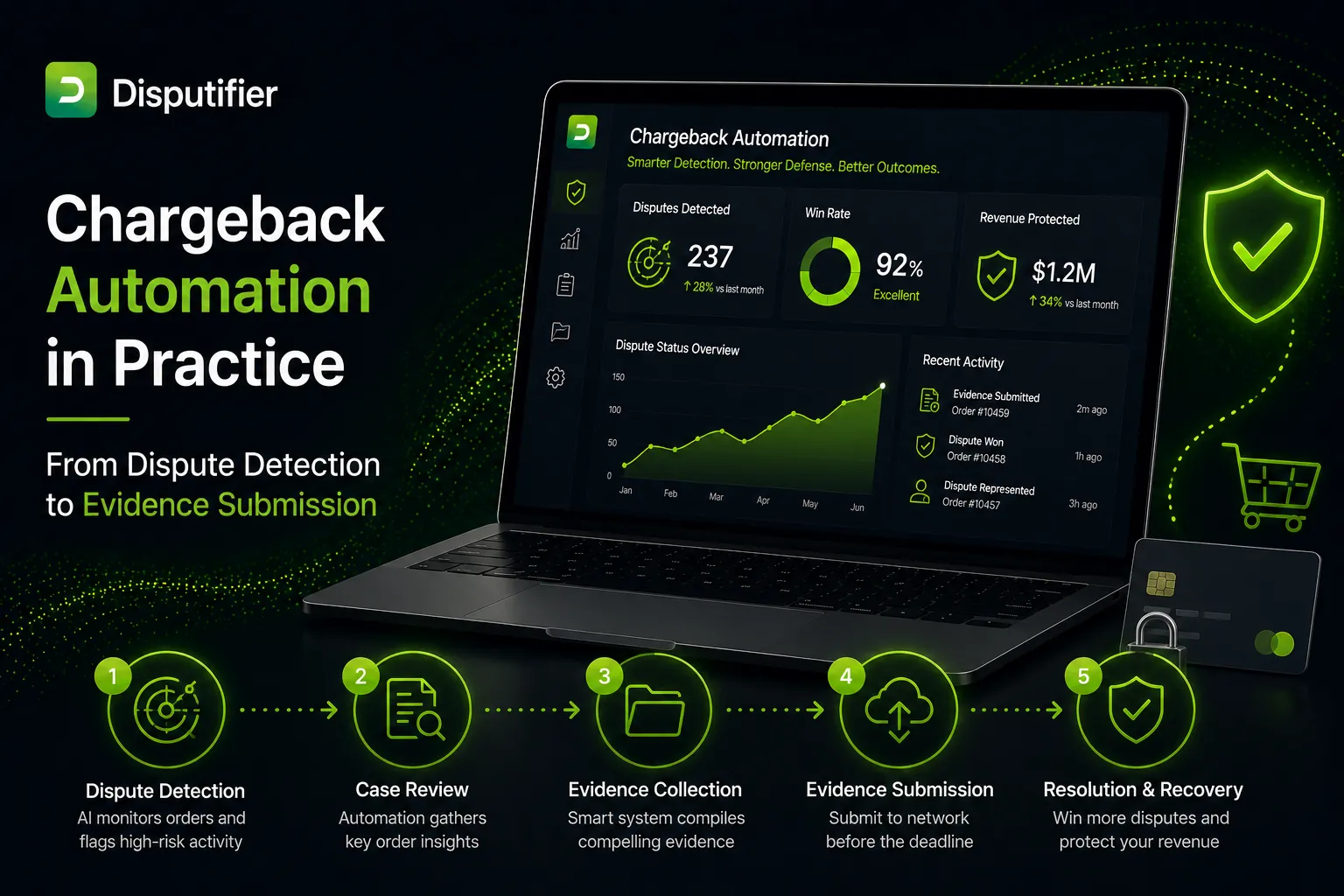
If you want faster dispute detection, stronger evidence packages, and higher win rates, you need automation that covers the entire lifecycle - not just alerts. This guide breaks down what real chargeback automation looks like in practice, how it works step by step, and why leading ecommerce brands now rely on platforms like Disputifier to manage everything from detection to submission.
Before diving in, you may want to review related resources like the guide on how long chargebacks take, the breakdown of what counts as compelling evidence, and the overview of chargeback automation benefits.
What Chargeback Automation Really Means for Ecommerce
Chargeback automation is more than a notification system. At its best, it should:
- identify disputes instantly
- gather correct evidence
- create a compliant response package
- submit automatically
- track outcomes
- optimize prevention based on patterns
Most merchants handle this manually - digging through customer emails, verifying order data, exporting invoices, grabbing tracking info, and piecing everything together. It’s slow, inconsistent, and error-prone.
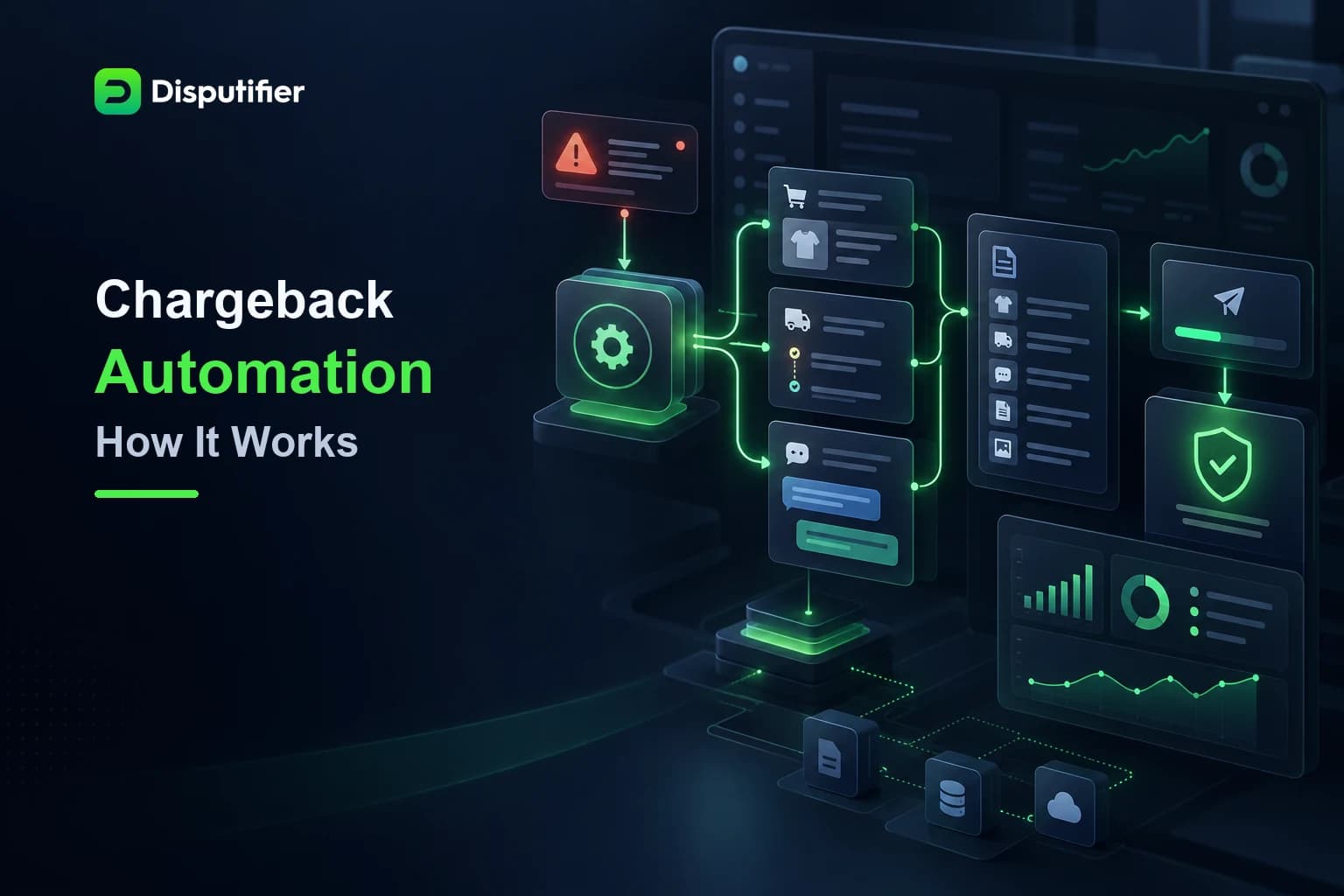
Automation removes these friction points. When a dispute hits, the system pulls everything needed, assembles it correctly, and sends it back before deadlines hit.
Step 1: Automated Detection the Second a Dispute Hits
Manual detection is one of the biggest reasons merchants lose chargebacks. Many merchants don’t see the dispute until days have passed, shrinking their response window.
Automation solves that.
The moment a network files a dispute - Visa, Mastercard, Amex, Discover, PayPal, Klarna, or a bank - the platform detects it instantly. That alone lifts win rates.
Step 2: Automated Evidence Collection
Once detected, the system immediately gathers:
- order details
- communication logs
- fulfillment and tracking data
- device fingerprinting
- BIN intelligence
- product info
- subscription logs
- customer history
Automated evidence collection eliminates missed documents and saves hours per dispute.
This aligns with insights from your guide on customer communication proof that wins disputes.
Step 3: Reason-Code-Specific Template Assembly
Every card network and reason code has unique evidence requirements. A “Product Not Received” dispute requires very different proof compared to a “Fraud - Card Not Present” claim.
Disputifier’s AI-driven logic:
- maps evidence to reason code
- assembles a formatted, compliant response
- ensures all required documents are attached
- eliminates human error in packaging
This expands on the processes outlined in your breakdown of compelling evidence by reason code.
Step 4: Automated Submission Before Deadlines
Missing deadlines guarantees a loss.
Automation ensures:
- no dispute sits waiting for someone on your team
- submissions go out quickly
- formatting meets network compliance
- merchants never lose due to late filing
For more context, merchants can reference the guide on pre-arbitration deadlines vs chargeback time limits.
Step 5: Automated Win/Loss Tracking and Analytics
You can’t reduce disputes if you don’t know what’s causing them.
Automation tracks:
- win/loss by reason code
- win/loss by product
- repeat offenders
- high-risk regions
- carrier issues
- BIN-level fraud patterns
- friendly fraud trends
These insights power prevention strategies, especially for brands shipping internationally. This connects with the breakdown in your post on handling international orders without spiking chargebacks.
Step 6: Prevention Through BIN Intelligence and Alerts
Chargeback automation also acts as a prevention engine.
BIN Intelligence
Running BIN checks before fulfillment or even at checkout helps:
- identify high-risk issuers
- detect mismatched regions
- flag prepaid cards
- catch abnormal patterns early
Useful related content includes:
Real-Time Alerts
Alerts allow merchants to refund transactions before banks finalize them as chargebacks.
When paired with automation, alerts:
- reduce dispute volume
- protect your chargeback ratio
- keep accounts healthy
For a breakdown of alert types, see your post on Ethoca vs Verifi vs Alerts.
Why Automation Is Essential in 2025
Chargebacks have become far more complex. Networks now enforce more proof, shorter deadlines, and stricter formatting.
Automation is essential because:
- manual workflows cannot meet deadlines
- dispute volume scales with business growth
- fraud rings evolve rapidly
- networks shift more responsibility to merchants
- human teams make mistakes under pressure
If your team is overwhelmed or your ratios are rising, automation is the only sustainable solution.
Why Ecommerce Brands Choose Disputifier
Disputifier automates the entire chargeback lifecycle:
- instant dispute detection
- automatic evidence collection
- reason-code-specific proof assembly
- compliant submission
- detailed analytics
- fraud pattern recognition
- alert integration
- BIN intelligence with AI
- friendly fraud identification
Merchants rely on Disputifier because it:
- increases win rates
- eliminates manual work
- protects revenue
- reduces dispute volume
- helps maintain healthy processing accounts
If you want fewer chargebacks, higher recoveries, and less labor, automation is the most reliable path forward.
FAQ
Does automation really improve win rates?
Yes. Automated evidence-building ensures correctness, consistency, and compliance.
What if evidence is missing?
Automation grabs all available data. It can’t manufacture missing documents, but it maximizes what you do have.
Does this help prevent disputes?
Yes. Combined with alerts and BIN intelligence, automation reduces dispute volume before it reaches the chargeback stage.
Can small merchants benefit?
Absolutely. Even low-volume stores risk account shutdowns if ratios spike. Automation protects them.
How does Disputifier compare to manual response teams?
Automation is faster, more accurate, and significantly more scalable.
Start Automating Your Chargebacks
Chargeback workloads don’t need to drain your time or revenue. Automation lets you detect earlier, submit faster, and win more - all with less effort.
To see what Disputifier can automate for your brand, try it or start with the free BIN lookup tool:
https://www.disputifier.com/bin-lookup