 All Posts


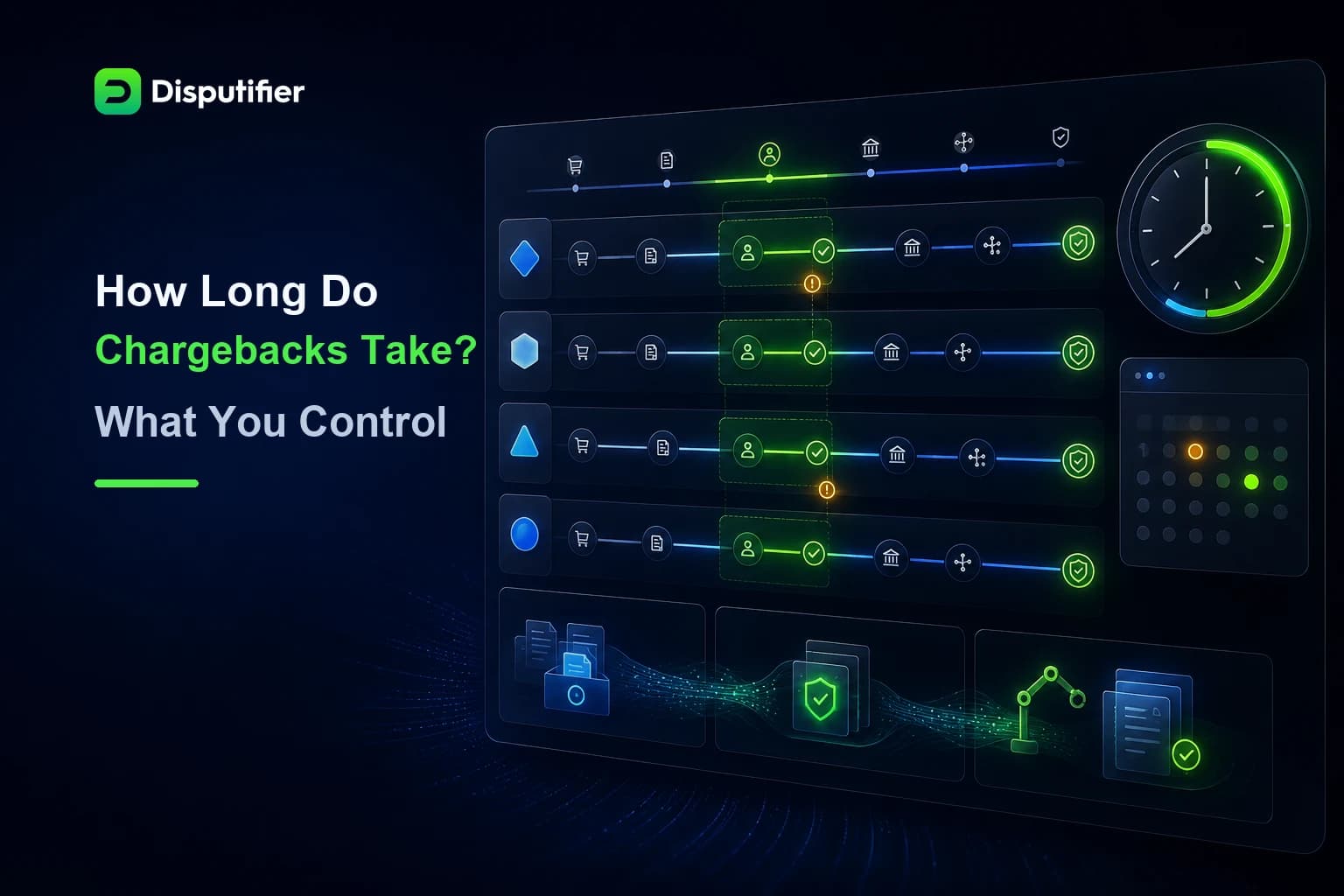
Chargebacks rarely move fast. Between cardholder claims, acquirer reviews, and network deadlines, even a simple case can drag out for months. Understanding how long chargebacks take - by card network and dispute phase - can help you plan better, stay compliant, and respond efficiently.
This guide breaks down the chargeback timelines for Visa, Mastercard, PayPal, and more, while also showing how tools like Disputifier automate dispute handling so you never miss a deadline again.
How the chargeback process timeline works
Every chargeback follows a structured path through several stages. Here’s a simplified view:
- Dispute filed: The cardholder contacts their bank to challenge a transaction.
- Bank review: The issuing bank investigates and decides whether to file a chargeback.
- Merchant response: The merchant receives a chargeback notice and must submit compelling evidence within a set timeframe.
- Issuer review: The issuer reviews the merchant’s evidence and makes a decision.
- Pre-arbitration or arbitration: If either side disputes the outcome, the case escalates further.
Each of these steps comes with strict time limits defined by the payment network.
For a detailed look at these timelines, see Pre-Arbitration Deadlines vs Chargeback Time Limits.
Visa chargeback timelines
Visa disputes can take anywhere from 30 to 150 days, depending on whether the case escalates to pre-arbitration.
- Cardholder files dispute: Within 540 days of the transaction date
- Merchant response: Typically 30 days from chargeback notice
- Issuer review: 30-45 days
- Pre-arbitration: 10-20 days for each round
- Arbitration (final decision): 30-75 days
Most Visa cases close within 90 days if not escalated, but those that reach arbitration can take up to 150 days total.
You can learn more about these stages in our post on Visa Chargeback Time Limits and the Merchant’s 540-Day Reality.
Mastercard chargeback timelines
Mastercard’s dispute flow typically lasts 45 to 120 days. The initial investigation and response period is faster than Visa’s, but arbitration cases still extend timelines significantly.
- Dispute filing: Within 120 days of transaction (some exceptions up to 540 days)
- Merchant response: 18-45 days depending on acquirer
- Issuer review: 30 days
- Arbitration: 45-60 days if escalated
The total duration depends on whether pre-arbitration or arbitration occurs. Merchants who respond quickly and submit proper documentation usually resolve Mastercard disputes in under 60 days.
American Express and Discover timelines
- American Express: 30-90 days total; merchant response time 20-30 days
- Discover: 45-120 days total; merchant response time 20-30 days
These networks often have faster resolutions since they directly handle the dispute process without passing through separate acquirers.
PayPal chargeback timelines
PayPal’s process differs slightly. Disputes typically resolve within 30 to 75 days, depending on the bank’s response and merchant evidence.
- Buyer dispute opened: Up to 180 days after purchase
- Merchant response window: 7-10 days
- PayPal review: 30-60 days
- Escalation to card issuer: Up to 30 additional days if unresolved
For more detail, read our post on PayPal Chargebacks: How to Prevent Holds and Rolling Reserves.
Factors that affect how long chargebacks take
Chargeback duration varies widely due to these factors:
- Card network: Visa disputes often take longer than PayPal or American Express.
- Response speed: Merchants who respond within 24-48 hours often shorten timelines.
- Pre-arbitration: Escalations can add weeks or even months.
- Evidence strength: Weak or incomplete evidence may lead to multiple review cycles.
- Automation level: Manual responses cause delays and missed deadlines.
Disputifier solves this last challenge by automating responses, deadlines, and submissions across all networks.
What merchants can control
While you can’t control how long card issuers take to review cases, you can dramatically shorten your internal response times and improve your win rates.
Here’s what you can control:
- Immediate response: Submit compelling evidence within 24 hours of receiving the chargeback.
- Consistent documentation: Keep invoices, tracking data, and communications organized.
- Automated alerts: Use chargeback alert tools to catch early warnings.
- Data accuracy: Ensure transaction data matches customer details exactly.
- Automation tools: Use Disputifier to handle disputes automatically, ensuring timely and complete responses.
If you want to understand what qualifies as strong documentation, review our post on What Counts as Compelling Evidence by Reason Code.
How automation shortens dispute timelines
Automation doesn’t just save time - it transforms the entire process. Disputifier’s AI-driven chargeback management platform can:
- Track every dispute and deadline automatically
- Generate and submit reason-code-specific evidence packets instantly
- Integrate with Visa Rapid Dispute Resolution (RDR) for immediate resolutions
- Send alerts the moment a new case appears
- Provide analytics to forecast dispute trends and improve prevention
By combining RDR automation, AI-driven evidence, and real-time alerts, Disputifier helps ecommerce merchants reduce chargeback timelines by up to 60%.
You can learn more about Visa RDR in our post on Rapid Dispute Resolution (RDR) for Visa.
The hidden cost of long disputes
Every day a chargeback remains unresolved ties up funds, increases risk ratios, and adds uncertainty to cash flow. Merchants relying on manual systems often experience:
- Delayed payouts: Banks may hold funds during dispute review periods.
- Rising chargeback ratios: Slow responses inflate ratios that can trigger penalties.
- Operational inefficiency: Teams waste hours chasing data across platforms.
Fast resolutions aren’t just about reclaiming funds - they protect your business reputation and prevent merchant account freezes.
The role of prevention in reducing future disputes
Preventing chargebacks entirely is more efficient than fighting them. Merchants can strengthen prevention by:
- Using real-time alerts to stop disputes before they escalate
- Implementing BIN checks to detect risky transactions
- Leveraging AI-based fraud detection tools
- Tracking recurring chargeback reasons through analytics
Disputifier combines all these functions - alerts, fraud tools, and automated evidence - into one seamless platform.
FAQ: Chargeback Timelines
How long do chargebacks take to resolve?
Most chargebacks take 30-90 days, but escalated disputes can last up to 150 days.
Which card network resolves disputes the fastest?
American Express and PayPal typically resolve disputes the quickest, while Visa cases can take the longest.
What can merchants do to speed up chargebacks?
Submit compelling evidence quickly and use automation tools like Disputifier to meet every deadline.
Do chargebacks always result in fund holds?
Not always, but many acquirers hold funds during active disputes - especially if chargeback ratios are high.
Can automation help with time limits?
Yes. Automation ensures you never miss a submission window or pre-arbitration response period.
Reduce dispute delays with Disputifier
Chargebacks will always take time - but how much time depends on your process. Disputifier gives ecommerce businesses control by automating dispute tracking, evidence creation, and deadline compliance across all payment networks.
Don’t wait for slow manual workflows to cost you more revenue. Try Disputifier and take control of your chargeback timelines today.