 All Posts


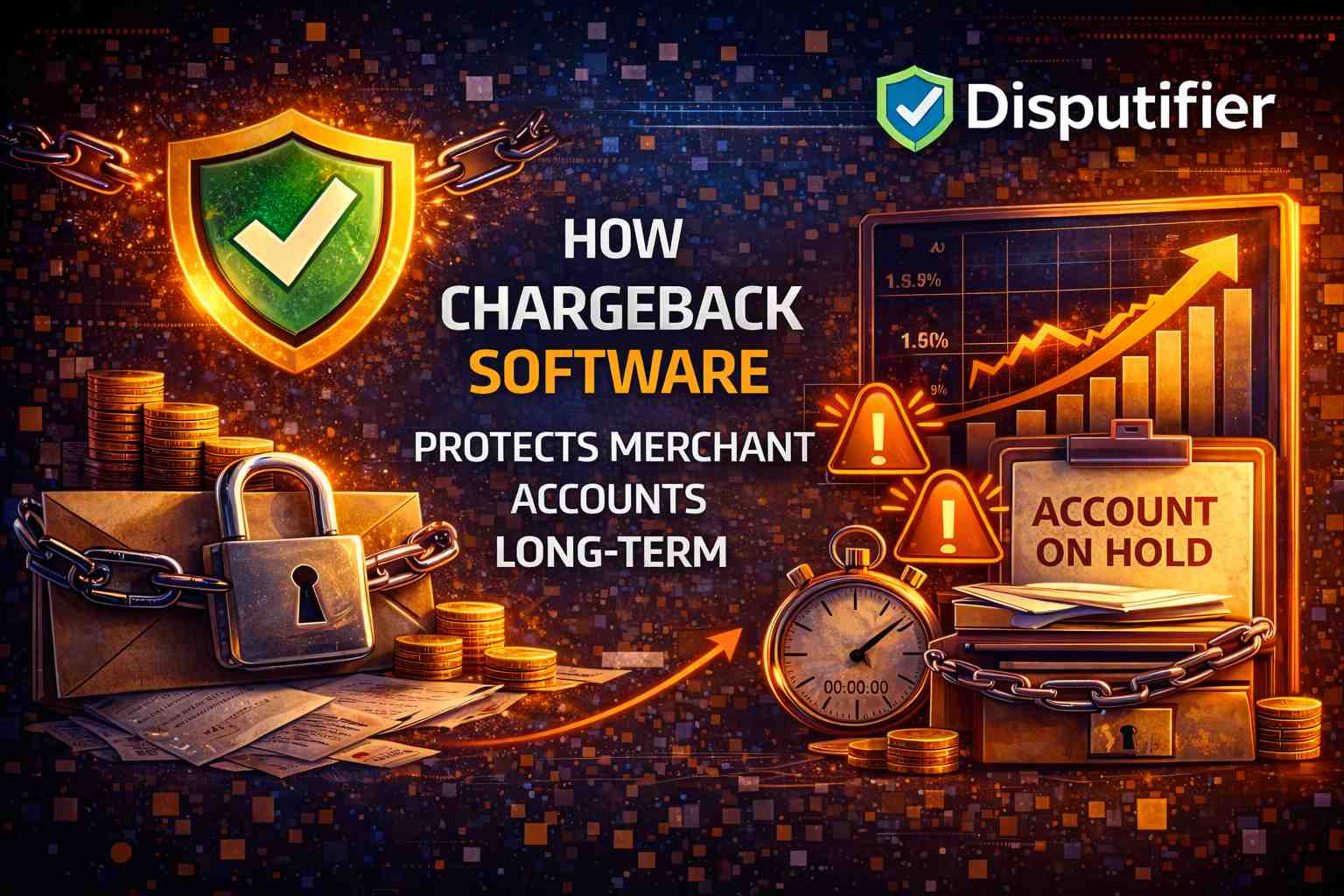
Chargeback software exists to protect merchant accounts long before a store ever reaches a breaking point.
For ecommerce founders and operators, a merchant account is not just a payment rail. It is the backbone of cash flow, scale, and survival. Once that account is flagged, restricted, or terminated, recovery becomes slow, expensive, and sometimes impossible.
Chargeback software for merchant account protection is no longer optional for growing ecommerce brands. It is long-term risk management.
This article explains how chargeback software protects merchant accounts over time, why payment processors care more about patterns than individual disputes, and how Disputifier helps ecommerce brands stay operational as they scale.
Merchant Accounts Fail Quietly Before They Fail Loudly
Most merchant accounts do not get shut down overnight.
They deteriorate gradually through rising chargeback ratios, increasing dispute response times, issuer distrust, and payment processor risk flags.
By the time a merchant receives a warning, the damage has usually been building for months.
This slow erosion is why understanding ratios matters, as explained in
Chargeback ratios explained: why they matter for your merchant account.
Why Chargebacks Threaten Merchant Accounts Long-Term
Chargebacks signal risk to every party in the payment chain.
Issuers interpret disputes as customer dissatisfaction. Networks interpret them as system abuse. Processors interpret them as liability.
Over time, this leads to increased processing fees, rolling reserves, payout delays, and account monitoring programs.
These consequences are detailed in
Why Stripe and Shopify hold funds and how to avoid payout delays.
Chargeback software protects merchant accounts by addressing these signals before they escalate.
Manual Chargeback Handling Increases Account Risk
Manual workflows introduce inconsistency.
Missed deadlines, incomplete evidence, and reactive handling all increase perceived risk. As dispute volume grows, manual handling becomes unsustainable, a breakdown explored in
When manual chargeback handling breaks down for ecommerce brands.
Chargeback software replaces human variability with consistent, auditable processes that payment processors trust.
Payment Processors Track Patterns, Not Individual Wins
Winning disputes does not guarantee merchant account safety.
Processors evaluate dispute frequency, reason code trends, response consistency, and prevention behavior.
This is why high-volume brands often face restrictions even with decent win rates.
Understanding dispute behavior over time is critical, as shown in
How often do merchants win chargebacks and how to improve your odds.
Chargeback software shifts focus from individual recoveries to systemic prevention.
How Chargeback Software Protects Merchant Accounts
Chargeback software protects merchant accounts by creating structure, visibility, and predictability.
Core protections include automated dispute intake, deadline tracking across networks, standardized evidence submission, prevention workflows, and analytics tied to risk.
This structure reduces uncertainty for payment processors and issuers.
Automation Prevents Silent Risk Accumulation
One of the biggest threats to merchant accounts is silent failure.
Unnoticed dispute spikes, delayed responses, and missed alerts accumulate until processors intervene. Automation closes these gaps, as outlined in
Chargeback automation in practice: from dispute detection to evidence submission.
Chargeback software ensures no dispute goes unseen and no deadline slips unnoticed.
Analytics Reveal Merchant Account Weak Points
Chargeback analytics expose risk before it becomes irreversible.
Analytics help identify products driving disputes, regions with higher issuer scrutiny, friendly fraud patterns, and policy mismatches.
This insight is expanded in
Chargeback analytics: find root causes and reduce fund holds.
Without analytics, merchants operate blind.
Friendly Fraud Is the Largest Long-Term Threat
Friendly fraud quietly destroys merchant accounts.
Customers forget purchases, abuse refund systems, or dispute out of convenience. Over time, this behavior inflates ratios and damages issuer trust.
Machine learning plays a critical role in identifying and reducing friendly fraud, as explained in
How machine learning reduces friendly fraud at scale.
Chargeback software that detects friendly fraud protects accounts by reducing unnecessary disputes.
BIN Intelligence Improves Issuer Trust
Issuers behave differently by region and bank.
Some require stronger documentation. Others escalate disputes faster. Treating all disputes the same increases risk.
BIN-level intelligence helps merchants adapt strategies to issuer behavior, as outlined in
BIN numbers explained: how banks, regions, and risk scores affect payouts.
Merchants can proactively assess issuer risk using Disputifier’s
free BIN checker.
Prevention Matters More Than Recovery
Merchant accounts survive through prevention, not recovery.
Proactive refunds, alerts, and customer communication reduce disputes before they file. This approach is detailed in
Prevent chargebacks with real-time alerts.
Chargeback software embeds prevention into daily operations.
How Disputifier Protects Merchant Accounts Long-Term
Disputifier is built to protect merchant accounts, not just win disputes.
It combines AI-driven dispute prioritization, automated evidence generation, friendly fraud detection, BIN and issuer intelligence, real-time alerts, and analytics tied directly to account risk.
Disputifier aligns dispute management with payment processor expectations, reducing long-term exposure.
This unified approach fits into the broader infrastructure described in
Ecommerce chargeback prevention tools: how to build a tech stack that actually works.
Merchant Account Protection Is a Growth Strategy
Stable merchant accounts enable predictable cash flow, higher processing limits, faster expansion, and stronger processor relationships.
Chargeback software protects merchant accounts so growth does not introduce existential risk.
If you want to understand how issuer behavior impacts your current transactions, review recent orders using the free BIN checker.
FAQ: Chargeback Software and Merchant Account Protection
What is chargeback software for merchant accounts?
Chargeback software helps merchants manage disputes, prevent chargebacks, and protect merchant accounts from restrictions or termination.
How do chargebacks affect merchant accounts long-term?
High chargeback ratios lead to monitoring programs, fund holds, higher fees, and possible account termination.
Can chargeback software reduce fund holds?
Yes. Consistent dispute handling, prevention, and analytics reduce processor risk signals.
Is chargeback software necessary for small stores?
As soon as disputes affect payouts or ratios, chargeback software becomes essential.
How does Disputifier protect merchant accounts differently?
Disputifier focuses on prevention, issuer intelligence, and long-term account health rather than short-term dispute wins.