 All Posts


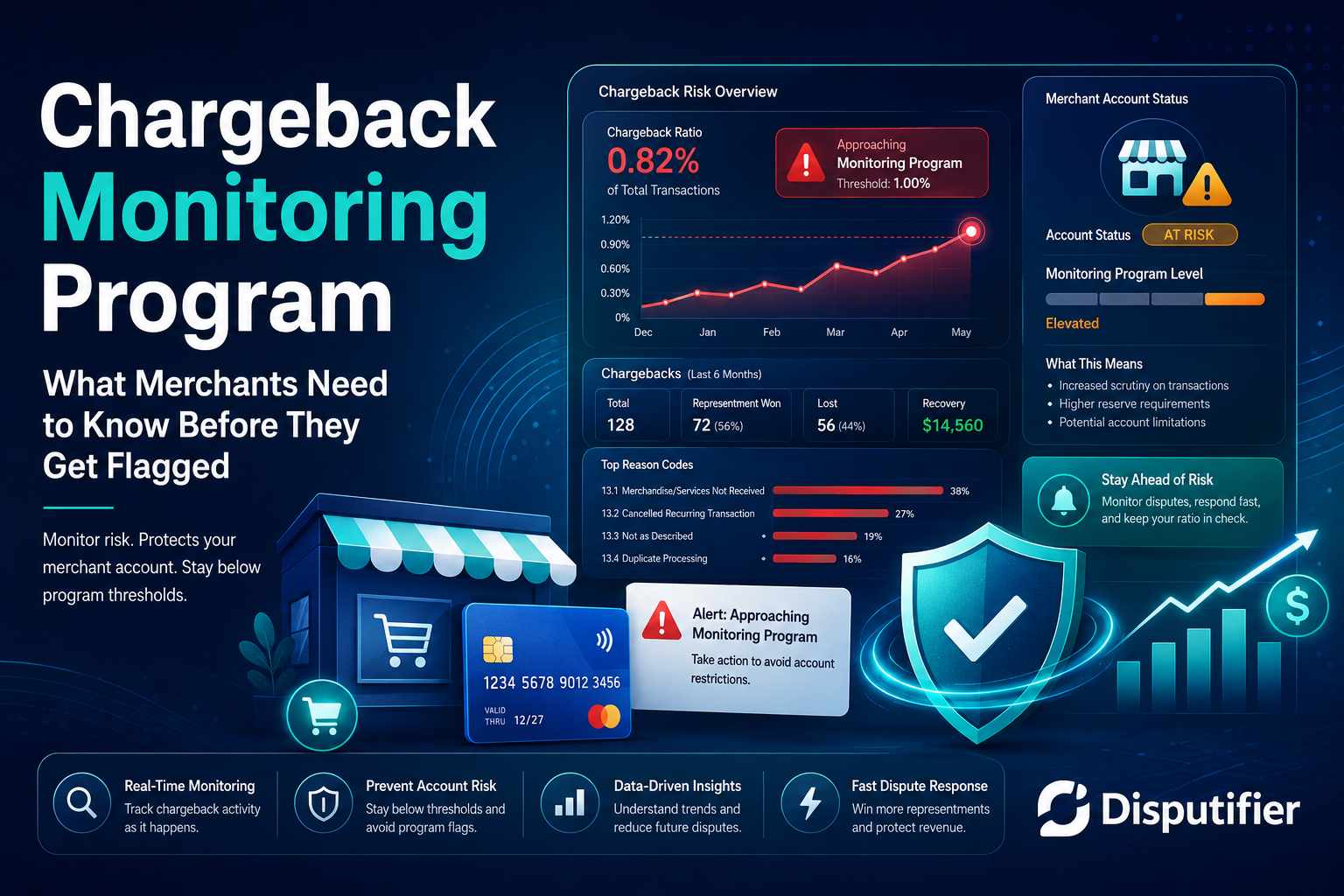
Most merchants don't think about chargeback monitoring programs until they're already in one. By that point, the fees are running, the restrictions are in place, and the clock is ticking to get your ratio back under control before your processor terminates your account.
Understanding how chargeback monitoring programs work - and what triggers them - is what keeps you out of them in the first place.
What a Chargeback Monitoring Program Actually Is
A chargeback monitoring program is a formal enforcement mechanism used by card networks and payment processors to identify merchants whose chargeback ratios exceed acceptable thresholds. When a merchant crosses those thresholds, they're placed into a program that comes with monthly fees, mandatory remediation plans, and a fixed window to bring their ratio back down.
If the merchant fails to reduce their ratio within that window, the consequences escalate - up to and including termination of their merchant account and placement on the MATCH list, which makes it extremely difficult to secure processing with any major provider.
Visa runs the Visa Dispute Monitoring Program (VDMP). Mastercard runs the Excessive Chargeback Program (ECP). Both operate on monthly chargeback ratio calculations, and both have tiered structures with escalating consequences the longer a merchant remains in the program.
What Triggers a Chargeback Monitoring Program
The specific thresholds vary by network and program tier, but the general triggers are consistent: too many chargebacks relative to your total transaction volume within a calendar month.
Visa's standard monitoring threshold sits at 0.9% chargeback ratio with 100 or more chargebacks in a month. Their high-risk tier - the Excessive Chargeback Merchant program - kicks in at 1.8% with 1,000 or more chargebacks. Mastercard's standard threshold is 1% with 100 chargebacks. Their Excessive Chargeback Merchant designation applies at 1.5% with 1,000 chargebacks.
Shopify chargeback percentage covers how to calculate and monitor your own ratio - understanding your number before your processor flags it gives you time to act.
Your processor also runs their own monitoring layer on top of the card network thresholds. Many processors begin applying scrutiny and informal pressure well below the network thresholds - which means by the time you receive an official program notification, the problem has often been building for months.
What Happens Once You're in a Monitoring Program
The moment your ratio crosses the threshold and a monitoring period begins, the financial consequences start immediately.
Visa charges merchants in the standard VDMP tier $50 per chargeback per month for months four through six of the program, escalating to $50 per chargeback per month plus disqualification risk from months seven onward. Mastercard's fee structure follows a similar escalation pattern.
Beyond the fees, your processor may impose additional conditions - increased rolling reserves, restricted processing limits, or requirements to implement specific fraud prevention measures before you can continue operating.
How chargebacks trigger rolling reserves and how to stop them explains how reserve requirements compound the financial pressure - your processor holds a percentage of your revenue as protection, which directly impacts your cash flow while you're already paying elevated fees.
The remediation window is typically three to six months depending on the program and tier. If your ratio doesn't come down fast enough, the program escalates. If it escalates far enough, your account is terminated.
Why Merchants End Up in Monitoring Programs
No merchant enters a chargeback monitoring program intentionally. It happens through a combination of factors that compound faster than most operators realize.
Fraud spikes are the most common trigger. A wave of fraudulent orders - often the result of a BIN testing or card testing attack - generates chargebacks that hit your ratio within 60 to 90 days of the original transactions. By the time the chargebacks appear, the fraud event that caused them is long over, but the ratio damage is already done.
What is card testing and how to stop it covers one of the most common attack vectors - fraudsters running small test charges through your store to validate stolen card numbers before using them for larger purchases elsewhere. Those test transactions generate chargebacks that accumulate quickly.
Subscription billing problems are another frequent cause. A missed cancellation, a billing descriptor change, or a failed renewal communication can trigger a wave of disputes within a single billing cycle. Subscription chargebacks are especially dangerous because they tend to cluster - multiple customers experiencing the same billing issue in the same window pushes your ratio up faster than one-off disputes.
Operational gaps complete the picture. Merchants who aren't monitoring their chargeback ratio actively, aren't responding to disputes consistently, or aren't catching fraud signals early enough often don't realize they're approaching a threshold until their processor tells them.
How to Stay Out of a Chargeback Monitoring Program
Prevention is significantly cheaper than remediation. Here's where the focus should be.
Monitor your chargeback ratio monthly, not quarterly. Your processor calculates your ratio every month - you should be doing the same. If your ratio is trending upward, you need to know before your processor does.
Chargeback ratios explained covers exactly how the calculation works and what factors affect it - understanding the math is the starting point for managing the number.
Respond to every dispute on time. Unanswered chargebacks are automatic losses that count against your ratio. Consistent dispute response is one of the most direct ways to keep your ratio from climbing unnecessarily. Even disputes you're unlikely to win should be responded to - the goal is to demonstrate to your processor that you have an active, functioning dispute management system.
Catch fraud before it ships. Every fraudulent order that reaches fulfillment is a potential chargeback 60 to 90 days later. Pre-fulfillment fraud screening - including BIN validation, AVS checks, and velocity monitoring - eliminates the root cause before it becomes a ratio problem.
Use Disputifier's free BIN checker to validate card data at the point of transaction and flag high-risk orders before they're processed.
Set up chargeback alerts. Networks like Ethoca and Verifi notify merchants of potential disputes before they're formally filed. Resolving those alerts with a refund removes the transaction from becoming a chargeback entirely - which means it never counts against your ratio. Setting up chargeback alerts is one of the most effective ratio management tools available.
How to Exit a Chargeback Monitoring Program Once You're In One
If you're already in a monitoring program, speed matters. You have a limited window to reduce your ratio before consequences escalate.
Start by identifying the root cause immediately. Look at your chargeback data by reason code, product type, and time period. Is the spike driven by fraud, friendly fraud, fulfillment failures, or subscription billing problems? The answer determines your remediation approach.
Chargeback analytics gives you the visibility to do this accurately - without data, remediation is guesswork.
Implement fraud prevention measures immediately if fraud is the driver. Add BIN validation, tighten your order review thresholds, and activate chargeback alerts across all card networks. Every fraudulent order you stop today is a chargeback that won't hit your ratio in 60 days.
Respond to every open dispute with strong evidence packages. Winning disputes doesn't reduce your chargeback count for ratio purposes - chargebacks are counted when filed, not when resolved - but consistent response demonstrates to your processor that you're managing the problem actively, which can influence how they handle your program status.
Communicate with your processor proactively. Processors have seen merchants exit monitoring programs before. If you can show a credible remediation plan and demonstrate early progress, many processors will work with you rather than escalate. Silence is the worst response.
How Disputifier Keeps Merchants Out of Monitoring Programs
Disputifier is chargeback prevention and dispute management software built to protect ecommerce merchants from exactly this kind of processor risk. It addresses the ratio problem from both ends - prevention before disputes are filed and automated response when they are.
On the prevention side, Disputifier's BIN intelligence validates card data in real time, flagging high-risk transactions before they're fulfilled. Its free BIN checker gives merchants immediate access to card issuer data, country of origin, and risk signals at the point of transaction - before a fraudulent order ships and becomes a chargeback 60 days later.
Disputifier integrates with Ethoca and Verifi alert networks automatically, resolving pre-dispute alerts before they become formal chargebacks. For merchants managing their ratio actively, those resolved alerts represent real disputes that never hit your count.
On the response side, Disputifier detects chargebacks the moment they're filed and immediately triggers an automated evidence-building workflow. Every dispute gets a response. Every deadline gets met. For merchants in or approaching a monitoring program, that consistency is critical - chargeback protection for merchants depends on having a system that never lets a response window close without action.
Disputifier's analytics surface the patterns driving your chargebacks - by reason code, product, customer segment, and time period - so you can fix root causes rather than just respond to individual disputes. That root-cause visibility is what makes sustained ratio improvement possible, not just short-term band-aids.
For Shopify merchants, Disputifier connects directly to your store, pulling order data, fulfillment records, and customer communication automatically so your dispute responses are built on complete, accurate evidence from the start.
If your ratio is trending upward or you're already in a monitoring program, Disputifier is the fastest path to getting it back under control. Start protecting your merchant account with Disputifier today.
Frequently Asked Questions
What is a chargeback monitoring program?
A chargeback monitoring program is a formal enforcement mechanism used by card networks like Visa and Mastercard to penalize merchants whose chargeback ratios exceed set thresholds. Merchants in these programs pay monthly fees and must reduce their ratio within a fixed window or risk losing their merchant account.
What chargeback ratio triggers a monitoring program?
Visa's standard threshold is 0.9% with 100 or more chargebacks per month. Mastercard's is 1% with 100 chargebacks. Both networks have higher-tier thresholds for more severe cases. Many processors apply informal scrutiny well below these levels.
How long do merchants have to exit a monitoring program?
The remediation window is typically three to six months depending on the program and tier. Merchants who fail to reduce their ratio within that window face escalating fees and eventual account termination.
Does winning a chargeback dispute reduce my ratio?
No. Chargeback ratios are calculated based on disputes filed, not disputes lost. Winning a dispute doesn't remove it from your ratio count - but consistent response demonstrates to your processor that you're managing the problem actively.
Can chargeback alerts help keep me out of a monitoring program?
Yes. Resolving a chargeback alert with a refund before a dispute is formally filed means the transaction never becomes a chargeback. It never counts against your ratio. Alert management is one of the most direct ratio control tools available to merchants.
What's the fastest way to reduce my chargeback ratio?
Stop new chargebacks from being filed - through fraud prevention, alert resolution, and improved order review - while responding to every existing dispute consistently. Disputifier automates both sides of that equation.
What happens if I'm placed on the MATCH list?
The MATCH list is a database used by acquiring banks to identify terminated merchants. Placement makes it extremely difficult to secure merchant processing with any major provider, effectively shutting down your ability to accept card payments.
Protect Your Merchant Account Before a Chargeback Monitoring Program Finds You
A chargeback monitoring program isn't a warning - it's a deadline. The merchants who avoid them are the ones who monitor their ratio proactively, catch fraud before it ships, and respond to every dispute automatically.
Disputifier gives ecommerce merchants the prevention tools, alert integrations, and automated dispute response to keep their ratio in check before a processor ever sends a notice. Don't wait for a monitoring program to force the issue. Get started with Disputifier today.