 All Posts


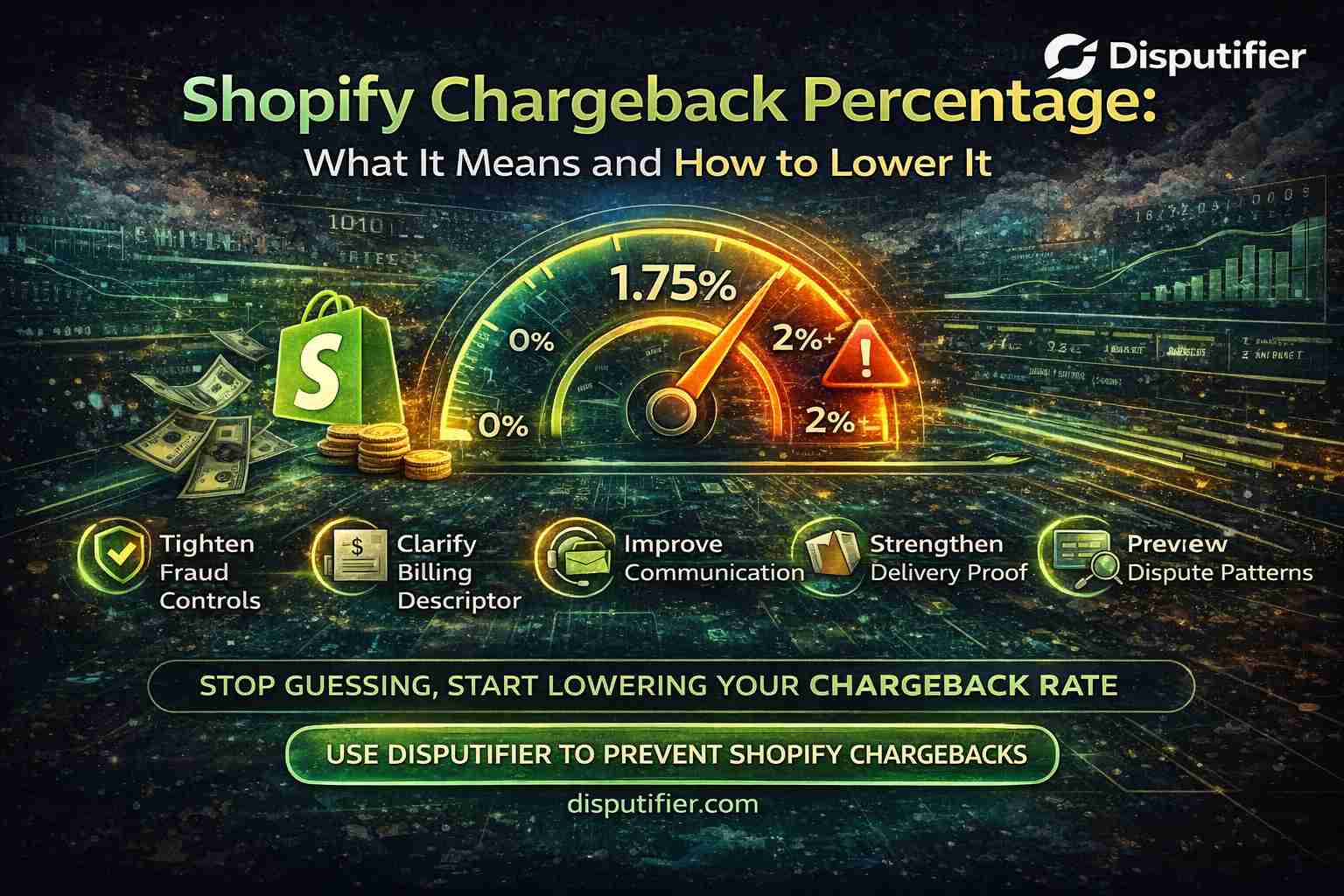
If you run a Shopify store, your chargeback percentage matters more than most merchants realize.
A lot of store owners think about chargebacks one case at a time. That is understandable. A dispute comes in, money gets pulled, the team scrambles, and the focus stays on that one order.
But payment providers do not look at chargebacks that way.
They look at patterns. They look at ratios. They look at whether your store is becoming a risk.
That is why understanding your Shopify chargeback percentage matters. It is one of the clearest signals of whether your fraud prevention, fulfillment, customer communication, and dispute workflows are actually working.
This guide breaks down what Shopify chargeback percentage means, why it matters, what causes it to rise, and how merchants can lower it with stronger systems.
If you want the broader foundation first, start with How to Prevent Chargebacks in Shopify Stores.
What is Shopify chargeback percentage?
Shopify chargeback percentage is the rate at which your store’s orders or transactions turn into chargebacks.
In practice, merchants usually think about it as the share of processed transactions that result in disputes or chargebacks over a given period.
The exact ratio calculation can vary depending on who is measuring it. Your processor, card network, or payments provider may use slightly different timing rules or denominator logic. But the core idea stays the same:
It shows how often your store is generating chargebacks relative to your payment volume.
That is what makes it so important.
A single chargeback can be annoying. A rising chargeback percentage can become a business risk.
Why Shopify chargeback percentage matters
Your chargeback percentage matters because it affects far more than refunded revenue.
If it climbs too high, it can lead to:
- increased processor scrutiny
- reserve requirements
- payout delays
- higher monitoring pressure
- worse merchant account health
- higher operational cost
- more time lost to dispute handling
That is why merchants should stop thinking only about “winning disputes” and start thinking about “controlling the chargeback rate.”
The healthiest Shopify stores do not just respond better. They generate fewer preventable disputes in the first place.
For the broader merchant-account angle, read Chargeback Ratios Explained: Why They Matter for Your Merchant Account.
What causes a high Shopify chargeback percentage?
A high Shopify chargeback percentage usually comes from a mix of problems, not one single issue.
The most common causes include:
Fraud getting through checkout
If stolen-card transactions or high-risk orders are being approved too easily, future fraud chargebacks become more likely.
Friendly fraud
A real customer receives the order but disputes the charge anyway. This often happens because of confusion, regret, descriptor issues, or deliberate abuse.
Poor post-purchase communication
If the customer does not understand the order status, shipping timeline, or how to contact support, the odds of a dispute rise.
Weak delivery proof
If you cannot clearly prove fulfillment, “item not received” disputes become easier for the cardholder to win.
Product mismatch
If the item delivered does not match expectations, the chargeback risk rises fast.
Weak internal workflows
Some merchants lose too many disputes because records are scattered, evidence is weak, or response deadlines are missed.
That is why lowering chargeback percentage requires operational fixes, not just better rebuttal letters.
What is considered a risky chargeback percentage?
Merchants should treat any rising trend seriously before it becomes a formal threshold problem.
The biggest mistake is waiting until the processor makes it your problem.
By the time that happens, you are already behind.
A dangerous chargeback percentage is not just “one that crosses a public threshold.” It is one that is trending upward, becoming harder to control, and exposing your store to increasing operational and payment risk.
That is why merchants should watch the trend line, not just the latest number.
If you want the full operational context, read What Is a Chargeback? The Complete Ecommerce Guide.
How to calculate your Shopify chargeback percentage
The basic concept is simple:
Chargeback percentage = chargebacks divided by total processed transactions over a given period
Some providers use transaction count. Others may focus on broader monitoring logic tied to timing windows. That is why the number you see in one system may not always match another perfectly.
The important point is not obsessing over decimal differences. The important point is tracking whether the percentage is improving or getting worse.
Merchants should review:
- monthly chargebacks
- transaction volume
- order volume
- dispute reasons
- trends by product or channel
- trends by geography
- trends by payment pattern
That gives you a much better operational picture than just counting disputes in isolation.
How to lower Shopify chargeback percentage
If you want to lower your Shopify chargeback percentage, you need to reduce preventable disputes at the source.
Here is what actually helps.
Tighten fraud screening
Fraud prevention is one of the fastest ways to lower future chargebacks.
You should review:
- AVS and CVV enforcement
- billing and shipping mismatch
- high-risk geography
- device patterns
- unusual order value
- order velocity
- suspicious new-customer behavior
This is also where card-level analysis helps. Disputifier’s free BIN checker gives merchants a practical way to review issuing-bank and card-related context when evaluating transaction risk.
For a deeper look, read What Is BIN Testing and How Merchants Can Stop It and How BIN Data Helps Detect Fraud Before It Happens.
Improve billing descriptor clarity
A confusing billing descriptor creates avoidable disputes.
If the name on the statement looks unfamiliar, some customers assume fraud and call the bank instead of contacting your team.
This is especially common for Shopify stores operating under one brand name while billing under another legal or processor-facing name.
Make the descriptor as recognizable as possible.
Improve customer communication
A lot of chargebacks are really communication failures in disguise.
You should send:
- order confirmations
- shipping updates
- delivery notifications
- refund confirmations
- subscription reminders when relevant
- clear support replies
This lowers confusion and gives you stronger records later if a chargeback still happens.
For more on this, read Customer Communication Proof That Actually Wins Disputes.
Strengthen delivery proof
“Item not received” claims are one of the easiest ways for a store’s chargeback percentage to rise.
That is why Shopify merchants should use:
- tracking on every order
- delivery confirmation
- signature confirmation for higher-value orders
- clear shipment status history
- proactive shipping communication
Delivery proof is not just a shipping detail. It is part of chargeback prevention.
Make refunds and support easy
If a customer can reach the bank faster than they can reach your support team, your chargeback percentage will eventually reflect that.
Good stores make it easy to:
- understand the return policy
- request support
- ask for a refund
- resolve problems before escalation
The harder it is to get help, the more likely the bank becomes the shortcut.
Prepare evidence before you need it
Merchants often lose chargebacks they should have won because they wait until the dispute lands to gather records.
That creates weak responses and missed deadlines.
You should already be able to access:
- order confirmations
- AVS and CVV results
- tracking data
- customer messages
- refund or cancellation logs
- product page screenshots where needed
- policy acceptance records
If you want the step-by-step response side, read How to Win a Chargeback: Step-by-Step for Ecommerce.
Review dispute patterns, not just disputes
This is where real improvement happens.
If your Shopify chargeback percentage is rising, ask:
- Which products generate the most disputes?
- Which reason codes show up most often?
- Which markets are riskier?
- Which traffic sources are producing bad orders?
- Which customer-service gaps keep repeating?
- Which fraud signals were missed?
This is how merchants turn chargeback reduction into a real system instead of just cleanup work.
Why Shopify stores struggle to lower chargeback percentage manually
Manual chargeback management looks manageable until order volume grows.
Then it starts breaking.
The most common failures are:
Evidence lives in too many places
Order history, payment data, support logs, and shipping proof sit in separate systems.
Teams become inconsistent
Different people make different decisions. Some disputes get fought well. Others get weak responses.
Patterns stay hidden
Without central analytics, merchants know they have chargebacks but not why the same problems keep repeating.
The business stays reactive
Instead of preventing next month’s disputes, the team just survives this week’s chargebacks.
That is why many Shopify stores eventually need something stronger than pieced-together manual workflows.
Why Disputifier matters for Shopify chargeback percentage
Disputifier matters because lowering chargeback percentage requires more than one tool.
You need something that helps connect fraud prevention, alerts, evidence, analytics, and dispute workflows in one operational system.
That is exactly where Disputifier fits.
Disputifier helps merchants reduce chargebacks earlier
Disputifier helps merchants improve the quality of order-level decision-making before the dispute even exists.
That means stronger fraud visibility, better payment context, and better control over risky transactions.
Disputifier helps merchants use Shopify dispute workflows more intelligently
Shopify stores often move fast, which makes weak dispute workflows more dangerous.
Disputifier helps merchants respond more consistently by improving access to evidence, workflow context, and case-level information.
If you want a Shopify-specific operational angle, read Shopify Chargeback and Dispute Management Automation for High-Volume Stores.
Disputifier helps merchants connect chargeback causes with actual outcomes
This is where many merchants stay blind.
Disputifier helps connect chargeback patterns, fraud indicators, customer behavior, and business outcomes so merchants can fix root causes instead of repeating them.
Disputifier helps protect long-term merchant account health
The goal is not just to reduce this month’s disputes.
It is to build a healthier chargeback trend over time, lower payment risk, and make the store more scalable.
That is exactly why a tool like Disputifier matters for merchants who are already feeling the pain of rising chargeback percentage.
Best practices for Shopify merchants trying to lower chargeback percentage
If you want the short version, focus on these areas:
1. Tighten fraud controls
Catch risky orders before fulfillment.
2. Improve descriptor clarity
Reduce confusion at the statement level.
3. Improve communication
Reduce support-triggered disputes.
4. Keep stronger proof
Especially around delivery and customer contact.
5. Organize evidence
Make chargeback response faster and more relevant.
6. Review analytics
Fix the repeat causes, not just the latest case.
7. Use better systems
Manual workflows do not scale well for growing Shopify stores.
If you want the broader toolset angle, read Best Chargeback Prevention Tools for Ecommerce.
Build a healthier Shopify chargeback trend
If your Shopify chargeback percentage is rising, the answer is not to panic over one metric.
The answer is to strengthen the system behind the metric.
That means better fraud controls, clearer billing, stronger delivery proof, easier customer resolution, better evidence readiness, and analytics that show you what is actually driving disputes.
That is where Disputifier helps.
It gives ecommerce merchants a smarter way to reduce chargeback risk, improve dispute workflows, and protect payment health as the store grows.
Start by tightening your fraud review and using Disputifier’s free BIN checker to add stronger card-level context to your Shopify risk workflow.
A lower Shopify chargeback percentage does not come from hoping fewer disputes show up. It comes from building a store that creates fewer preventable disputes in the first place.
Frequently Asked Questions
What is Shopify chargeback percentage?
Shopify chargeback percentage is the rate at which your processed transactions turn into chargebacks over a given time period.
Why does Shopify chargeback percentage matter?
It matters because it affects revenue, processor trust, dispute workload, and long-term merchant account health.
What causes a high Shopify chargeback percentage?
Common causes include fraud, friendly fraud, weak delivery proof, poor customer communication, product mismatch, and weak internal dispute workflows.
How can I lower my Shopify chargeback percentage?
You can lower it by tightening fraud screening, improving descriptor clarity, strengthening shipping proof, improving customer communication, preparing evidence early, and reviewing dispute patterns.
Why is Disputifier useful for Shopify merchants?
Disputifier helps merchants reduce chargeback risk by connecting fraud prevention, evidence, dispute workflows, analytics, and payment insight into a stronger system.