 All Posts


Card testing is one of the most common early-stage fraud problems in ecommerce.
It often starts quietly. A store sees a spike in failed payment attempts, a burst of low-value authorizations, or unusual checkout behavior that does not look like normal buying. Then, if nothing gets stopped, the real damage follows: fraud orders, chargebacks, payment processor scrutiny, and wasted support time.
That is why merchants need to understand card testing.
This is not just a technical payments issue. It is a fraud detection issue, a checkout-controls issue, and a chargeback-prevention issue.
If you run an online store, learning how card testing works helps you stop fraud earlier, tighten your payment controls, and protect revenue before bad transactions turn into bigger losses.
If you want the BIN-specific companion piece, read What Is BIN Testing and How Merchants Can Stop It.
What is card testing?
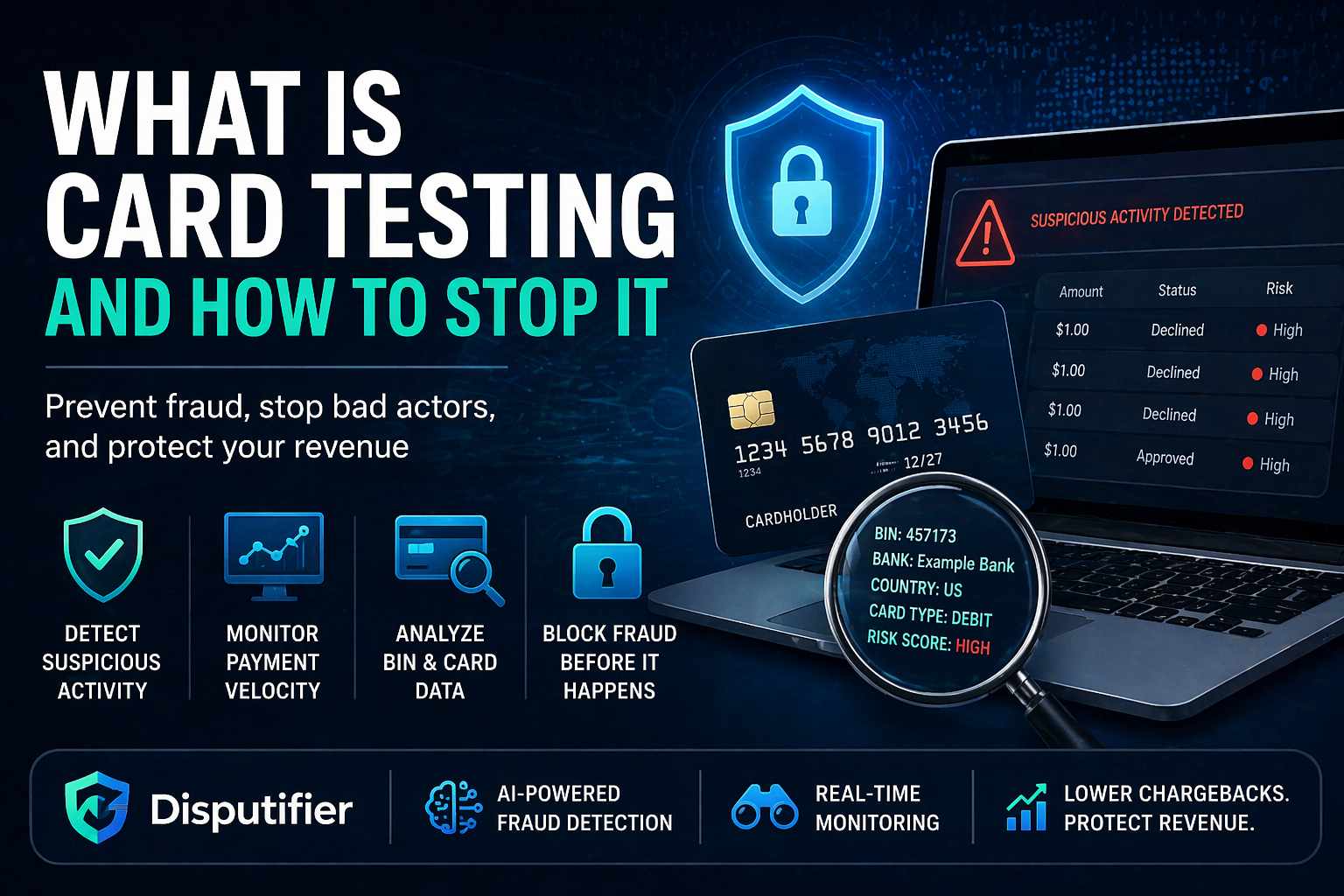
Card testing is a type of fraud where bad actors test stolen card details to see which cards still work.
They usually do this by running many small or repeated payment attempts through online checkout forms. The goal is not always to buy expensive products right away. Often, the goal is simply to verify which stolen cards are active so those cards can be used later for larger purchases.
That makes card testing dangerous even when the transaction amounts look small.
A failed or tiny transaction may not seem serious. But in many cases, it is just the start of a bigger fraud cycle.
Why card testing matters for ecommerce merchants
Card testing can hurt a store in several ways at once.
It can lead to:
- fraud losses
- higher chargeback risk
- processor warnings
- checkout instability
- wasted team time
- higher dispute volume later
- merchant account pressure
And the frustrating part is that it often starts before the merchant fully realizes what is happening.
That is why merchants should treat card testing as an early warning sign, not just a minor spike in payment noise.
If you want the wider fraud context, read Ecommerce Fraud Detection: How It Works and Which Signals Matter.
How card testing works
Fraudsters usually begin with stolen payment credentials.
Then they attempt to validate which cards are live by making repeated payment attempts through ecommerce checkout flows.
That may include:
- low-value purchases
- multiple rapid authorization attempts
- repeated attempts with slightly changed card details
- the same device or IP testing many cards
- targeting merchants with weaker payment controls
Once the fraudster identifies working cards, they may use them for larger fraudulent purchases or sell the validated data elsewhere.
That is why card testing should never be dismissed as harmless failed transactions.
Card testing vs BIN testing
These two terms are related, but they are not exactly the same.
Card testing is the broader behavior. It means testing stolen card details to find active cards.
BIN testing is a more specific form of that behavior. It uses known BIN ranges and issuing patterns to make testing more efficient.
In short:
- all BIN testing is a form of card testing
- not all card testing is specifically BIN testing
Merchants should care about both, because both signal fraud pressure and both can lead to future chargeback problems.
For the BIN-specific version, read How BIN Data Helps Detect Fraud Before It Happens.
Signs your store may be dealing with card testing
Card testing usually leaves a pattern.
Here are the most common warning signs.
Unusual spikes in failed payment attempts
If declines suddenly rise without a matching increase in legitimate orders, that is a major red flag.
Many low-value transactions
Fraudsters often start small to test whether the card works before attempting larger purchases.
Rapid order or payment velocity
Multiple payment attempts in a short period, especially with small variations, usually indicate something is wrong.
Strange behavior from the same device or IP
Fraudsters often repeat technical patterns even when they vary names, cards, or checkout details.
Similar card patterns across many attempts
Clusters of suspicious activity tied to similar card details or issuer patterns deserve attention.
Low-conversion bursts with high checkout activity
If checkout activity rises but actual clean conversions do not, card testing may be part of the reason.
Why card testing leads to chargebacks
Card testing is not just about failed authorizations.
If some of those cards get validated successfully, the fraudster may come back with larger purchases. Those purchases often become fraud chargebacks later.
That is why stopping card testing early reduces downstream chargeback risk.
If you let fraudsters use your store as a testing ground, you increase the chance that future orders become payment reversals, merchant account stress, and wasted ops time.
This is exactly why fraud prevention and chargeback prevention should not be treated as separate topics.
If you want the practical next layer, read How to Prevent Chargeback Fraud in Ecommerce.
How to stop card testing
Stopping card testing takes a layered approach. No single rule solves it.
Tighten checkout controls
Your checkout is the first place to harden.
Start by reviewing:
- AVS enforcement
- CVV enforcement
- velocity limits
- suspicious retry behavior
- friction for automated traffic
- minimum thresholds for suspicious payment attempts
Weak checkout controls make card testing easier. Stronger controls make your store less attractive as a fraud target.
Monitor payment velocity
Velocity is one of the strongest early fraud signals.
Watch for:
- repeated attempts in a short time frame
- many cards tried from one device
- repeated low-value authorizations
- several declines followed by one success
- bursts of payment activity without normal shopping behavior
Card testing often moves fast. Merchants who catch velocity patterns early usually stop more damage.
Use BIN intelligence
BIN intelligence adds useful context to payment activity.
A BIN can help identify card issuer details, region, and card type, which makes it easier to understand whether a transaction looks normal or suspicious in context.
This is one reason Disputifier’s free BIN checker is so useful. It gives merchants a direct way to review payment-level information and improve risk analysis around suspicious activity.
For more depth, read What Is a BIN Number and How Does It Work in Payments.
Review device behavior
A fraudster can rotate card details quickly. They often rotate technical behavior less well.
Look for:
- repeated use of the same device environment
- automation-like activity
- browser patterns that do not fit real shopper behavior
- repeated sessions tied to suspicious payment attempts
Device analysis helps merchants spot the pattern behind the payments.
Review IP and location signals
IP information should not be used blindly, but it is still valuable when paired with other risk signals.
Look for:
- suspicious international activity
- repeated traffic from the same IP range
- proxy or anonymized patterns
- mismatch between location signals and the order profile
Add order and customer context
A normal repeat customer behaves differently from a fraudster.
Good screening should also look at:
- account age
- past successful orders
- order size
- shipping urgency
- support history
- product mix
- mismatch between transaction behavior and customer history
That context helps reduce false positives while still catching real risk.
Where merchants get card testing wrong
A lot of merchants fail in predictable ways.
They assume failed attempts are harmless
They are not. A failed test can still mean your store is under active fraud pressure.
They rely only on basic platform defaults
Default settings may help, but often not enough to stop determined testing activity.
They treat fraud and chargebacks separately
This creates blind spots. The same activity that starts as card testing can become future fraud chargebacks.
They never review patterns
Card testing is easier to spot as a pattern than as an isolated transaction.
They stay too manual
By the time someone manually notices the issue, the fraudster may already have validated working cards.
Why Disputifier matters for card testing prevention
Disputifier matters because merchants need more than scattered fraud signals.
They need a way to connect payment intelligence, suspicious behavior, and downstream dispute risk into one clearer workflow.
That is exactly where Disputifier helps.
Disputifier helps merchants use BIN intelligence practically
BIN data is only useful if merchants can actually turn it into action.
Disputifier helps merchants use BIN intelligence to strengthen payment risk analysis and make faster fraud decisions. That is especially useful when suspicious card activity begins to appear in checkout behavior.
The free BIN checker gives merchants a simple but powerful way to add card-level context to fraud review.
Disputifier helps connect fraud signals to chargeback outcomes
This is a major advantage.
Card testing should not be viewed only as payment noise. It should be connected to what happens next: fraud orders, disputes, and loss patterns.
Disputifier helps merchants close that loop so fraud prevention gets smarter over time.
Disputifier helps reduce manual review pressure
Manual fraud handling breaks down quickly as order volume rises.
Disputifier helps merchants improve fraud workflows so suspicious activity can be assessed with better context and less chaos.
Disputifier helps protect long-term merchant account health
This is the bigger point.
Card testing is not only a transaction-level problem. Left unchecked, it becomes a payment-health problem.
Disputifier helps merchants strengthen fraud controls in a way that supports cleaner chargeback trends, stronger operational decisions, and healthier long-term payment performance.
If you want the broader system angle, read Chargeback Protection for Merchants: How It Works and What Actually Helps.
A practical card testing prevention checklist
If you want the short version, focus on these steps:
1. Tighten AVS and CVV checks
Do not make payment testing easy.
2. Monitor velocity
Rapid attempts are a major warning sign.
3. Use BIN analysis
Add payment context before suspicious behavior escalates.
4. Review device patterns
Fraudsters often repeat technical behavior.
5. Watch IP risk
Especially when it aligns with other suspicious signals.
6. Add customer context
Behavior matters more than isolated transactions.
7. Connect fraud and chargeback data
The downstream pattern matters.
Build a stronger defense against card testing
If you want to stop card testing, you need more than one fraud rule and more than a reactive mindset.
You need stronger checkout controls, better fraud detection, smarter payment analysis, and a system that helps your team act before suspicious transactions turn into fraud losses and chargebacks.
That is why Disputifier matters.
It helps ecommerce merchants use BIN intelligence more effectively, strengthen fraud review, reduce manual pressure, and protect revenue with a smarter operational workflow.
Start by tightening your checkout controls and using Disputifier’s free BIN checker to improve payment-level fraud analysis.
The merchants who stop card testing fastest are the ones who treat early warning signs seriously.
Frequently Asked Questions
What is card testing?
Card testing is a type of fraud where bad actors test stolen card details to see which cards are active and usable.
Is card testing the same as BIN testing?
BIN testing is a form of card testing. Card testing is the broader activity, while BIN testing uses BIN ranges and issuer patterns more specifically.
Why is card testing dangerous for ecommerce merchants?
It can lead to fraud losses, future chargebacks, processor pressure, checkout disruption, and merchant account risk.
How can merchants stop card testing?
Merchants can stop card testing by tightening checkout controls, monitoring payment velocity, reviewing device and IP behavior, and using stronger payment intelligence like BIN analysis.
Why is Disputifier useful for card testing prevention?
Disputifier helps merchants connect fraud signals, BIN intelligence, and downstream chargeback risk into a stronger fraud-prevention workflow.