 All Posts


Every ecommerce merchant faces the same tension: flag too few suspicious orders and fraud eats into your revenue. Flag too many and you block legitimate customers, tank your conversion rate, and damage the customer relationships you worked hard to build.
High-risk order review is where fraud prevention and revenue protection collide. Getting it right means building a review process that catches real fraud without treating good customers like criminals.
Why False Positives Are a Bigger Problem Than Most Merchants Realize
Blocking a fraudulent order saves you the transaction value. Blocking a legitimate order costs you the sale, the customer relationship, and potentially future lifetime value - and unlike fraud losses, false positives don't show up anywhere in your chargeback data.
Merchants who over-index on fraud prevention often don't see the full cost because declined legitimate orders are invisible losses. They don't generate chargebacks or dispute fees. They just quietly disappear from your revenue.
The goal of high-risk order review isn't to eliminate all risk - it's to make accurate decisions faster and with less manual effort. That requires a structured process, not a gut-feel approach.
What Makes an Order High Risk
Not every unusual order is a fraudulent one. Understanding which signals actually predict fraud - versus which ones just look unusual - is the foundation of a good review process.
Ecommerce fraud detection covers the full signal set, but the highest-value indicators for high-risk order review include mismatched billing and shipping addresses, BIN data that conflicts with the customer's stated location, AVS or CVV failures, velocity spikes from the same device or IP, and high-value orders placed by new accounts with no purchase history.
No single signal should trigger an automatic block. A billing-shipping address mismatch is normal for gift purchases. An international IP isn't inherently fraudulent. The combination of signals is what matters - and that's exactly what a risk scoring system helps you evaluate.
If you haven't set up ecommerce risk scoring yet, that's the logical starting point before building a manual review layer on top.
Building a Three-Tier Order Review System
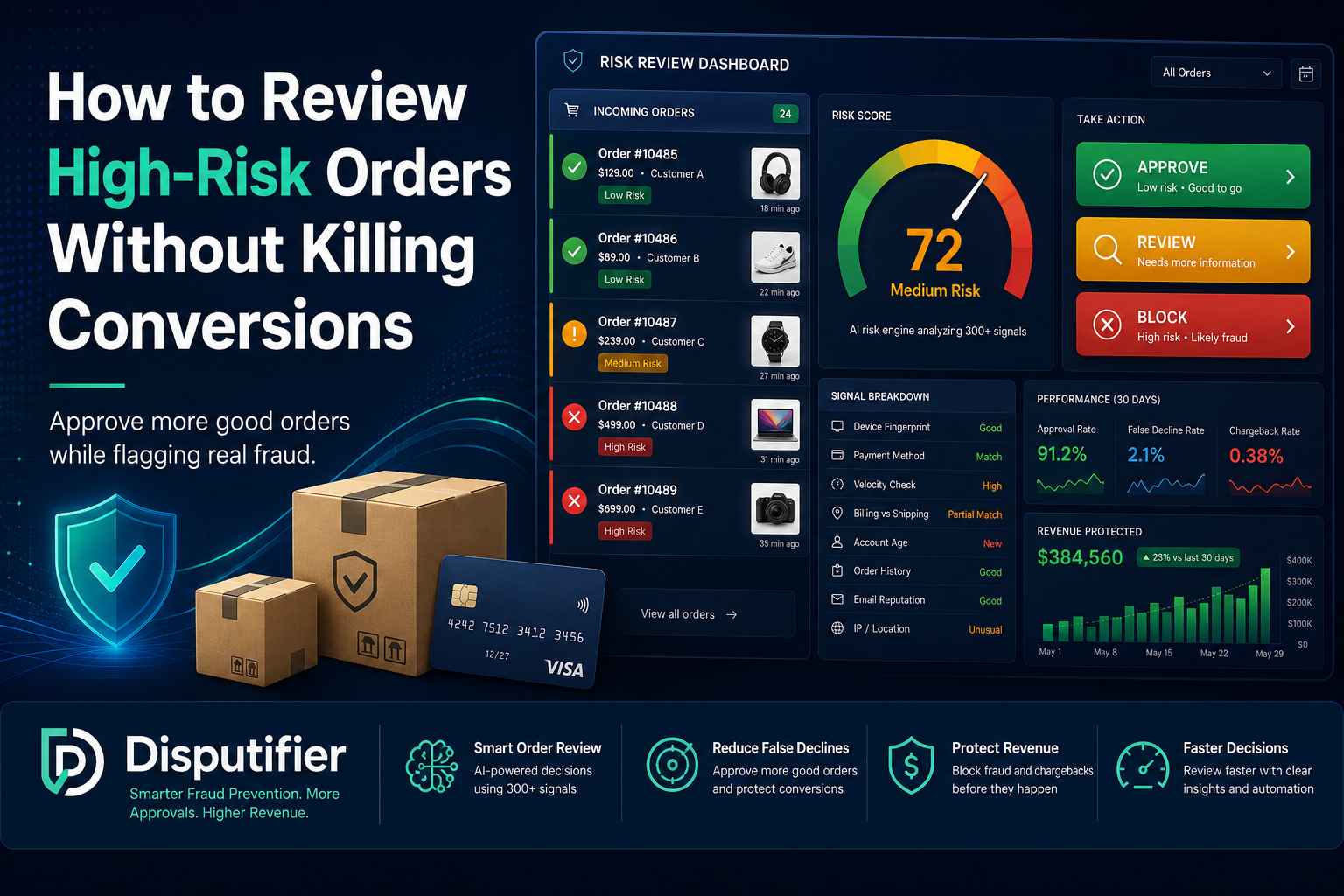
The most effective approach to high-risk orders is a tiered system that routes each order to the right outcome automatically - without your team having to make judgment calls on every transaction.
Tier one is auto-approve. Orders that score below your risk threshold - clean BIN data, matching addresses, known customer, no velocity flags - move straight to fulfillment without manual review. This is the majority of your order volume.
Tier two is manual review. Orders that fall in the middle of your risk range - one or two elevated signals, but not enough to warrant automatic rejection - go to a review queue. Your team evaluates these with the full signal picture available.
Tier three is auto-reject or hold. Orders that hit multiple high-risk signals simultaneously - BIN country mismatch, AVS failure, high value, new account, expedited shipping to a freight forwarder - get blocked or held pending additional verification.
The thresholds for each tier should be based on your own historical fraud and chargeback data, not generic industry benchmarks. How to prevent chargeback fraud in ecommerce covers how to build that historical picture and use it to set accurate thresholds.
How to Review a High-Risk Order Without Canceling It Outright
Most merchants default to two options when they see a suspicious order: approve it or cancel it. Both are blunt instruments. A structured review process gives you more options and better outcomes.
Start by looking at the full signal picture before making any decision. One flag isn't a pattern. Check whether the customer has ordered before, whether the email is associated with any prior activity, and whether the BIN data makes sense given the shipping destination.
Use Disputifier's free BIN checker to validate card data quickly. The BIN tells you the issuing bank, card type, and country of origin - and when that information conflicts with what the customer provided, it's a meaningful data point for your review.
If the order is ambiguous, request additional verification before canceling. Ask the customer to confirm their billing address, provide a photo ID, or verify via a phone number on file. Legitimate customers typically respond quickly. Fraudsters usually don't.
If you do need to cancel, do it cleanly. Send a clear explanation, offer an alternative payment method, and give the customer a path forward. That approach preserves the relationship if the customer was legitimate - and in borderline cases, many are.
The Signals That Most Often Indicate a Legitimate High-Risk Order
Learning to read positive signals is just as important as reading fraud signals. Several order patterns look risky but convert to legitimate purchases at high rates.
International orders with mismatched billing and shipping addresses are commonly flagged but frequently legitimate - especially for stores with a genuine international customer base. Handling international orders without spiking your chargebacks covers how to approach cross-border order review without blocking legitimate global customers.
High-value first-time orders are another pattern that triggers alerts but isn't inherently fraudulent. A new customer buying an expensive item isn't unusual if your product category attracts premium buyers. Context matters.
Expedited shipping on a gift order - where billing and shipping addresses differ and the shipping speed is unusually fast - reads as suspicious but often isn't. A positive BIN match and a clean device fingerprint can provide enough confidence to approve without review.
Where Manual Review Breaks Down at Scale
Manual review works until your order volume outpaces your team's capacity. At moderate volume, a dedicated fraud analyst can evaluate flagged orders with enough context to make good decisions. At high volume, the same process creates bottlenecks, delays fulfillment, and introduces inconsistency.
Chargeback protection for merchants depends on catching fraud early - but it also depends on processing legitimate orders quickly. When manual review slows fulfillment, you create a different kind of revenue problem.
The solution isn't to hire more reviewers. It's to automate the clear cases - both approvals and rejections - and reserve manual review for the genuinely ambiguous ones. That's what a properly configured fraud prevention system does.
How Disputifier Helps Merchants Review High-Risk Orders Smarter
Disputifier is ecommerce fraud prevention and chargeback management software built for online merchants who need to protect revenue without blocking legitimate customers.
Its BIN intelligence layer validates card data at the point of transaction, giving your review team immediate context on whether the card's issuing country, type, and bank match the customer's stated information. That single data point often resolves ambiguous orders in seconds. You can access Disputifier's free BIN checker to run card validation before making review decisions.
Disputifier's real-time fraud signals feed into your review queue automatically, surfacing the orders that actually need attention and filtering out the noise. Instead of your team reviewing every flagged order from scratch, they work from a prioritized queue with full signal context already attached.
When a high-risk order does result in a chargeback - whether because you approved it and it turned out to be fraud, or because a legitimate customer disputed a held order - Disputifier detects the dispute immediately and builds an automated evidence response. No missed deadlines. No manual evidence gathering.
For Shopify merchants, Disputifier integrates directly with your store, pulling order data, fulfillment records, and customer communication into a unified view. That means your review team always has the full picture without switching between systems.
Disputifier's analytics also help you refine your thresholds over time. If your review queue is consistently approving orders from a particular signal pattern, that pattern should move to auto-approve. If a pattern that was auto-approving is generating chargebacks, it needs a higher risk score. Disputifier surfaces those patterns so your system improves continuously.
Stop managing high-risk orders on instinct. Start using Disputifier to build a review process that protects revenue without blocking customers.
Frequently Asked Questions
**What makes an order high risk in ecommerce?**High-risk orders typically show multiple fraud signals simultaneously - mismatched billing and shipping addresses, BIN data that conflicts with the customer's location, AVS or CVV failures, velocity spikes, or high-value purchases from new accounts. No single signal defines high risk; the combination does.
**How do I review high-risk orders without canceling legitimate ones?**Build a tiered review system that auto-approves clean orders, flags ambiguous ones for manual review, and blocks only those that hit multiple strong fraud indicators. For orders in the review tier, use BIN validation, request additional customer verification, and look at the full signal picture before making a decision.
**What is a false positive in fraud prevention?**A false positive is a legitimate order that your fraud system incorrectly flags or blocks. False positives are often invisible in standard reporting because declined orders don't generate chargebacks - but they represent real revenue loss and damaged customer relationships.
**How does BIN data help with high-risk order review?**BIN data identifies the issuing bank, card type, and country of origin. When that information conflicts with what a customer provides - billing country, IP location, shipping destination - it signals elevated risk. Disputifier's free BIN checker lets you validate this instantly.
**When should I request additional verification instead of canceling?**When an order has one or two elevated signals but nothing definitive, additional verification is almost always the better option. Asking a customer to confirm their billing address or provide a secondary ID preserves the sale if they're legitimate - and legitimate customers typically respond quickly.
**How does Disputifier support high-risk order review?**Disputifier surfaces BIN intelligence and real-time fraud signals at the order level, giving your team the context they need to make accurate review decisions faster. When flagged orders do result in disputes, Disputifier automates the evidence response so no deadlines are missed.
**At what order volume does manual review stop being practical?**There's no universal threshold, but most merchants find that manual review becomes unsustainable somewhere between a few hundred and a few thousand orders per day. The right answer is to automate clear approvals and rejections, and reserve human judgment for genuinely ambiguous cases.
Review High-Risk Orders With Precision - Not Paranoia
The merchants who get high-risk order review right aren't the ones who block the most orders. They're the ones who make accurate decisions quickly, preserve legitimate revenue, and catch real fraud before it ships.
Disputifier gives you the BIN intelligence, real-time fraud signals, and automated dispute management to build that kind of precision into your review process. Protect your store without killing your conversions. Get started with Disputifier today.