 All Posts


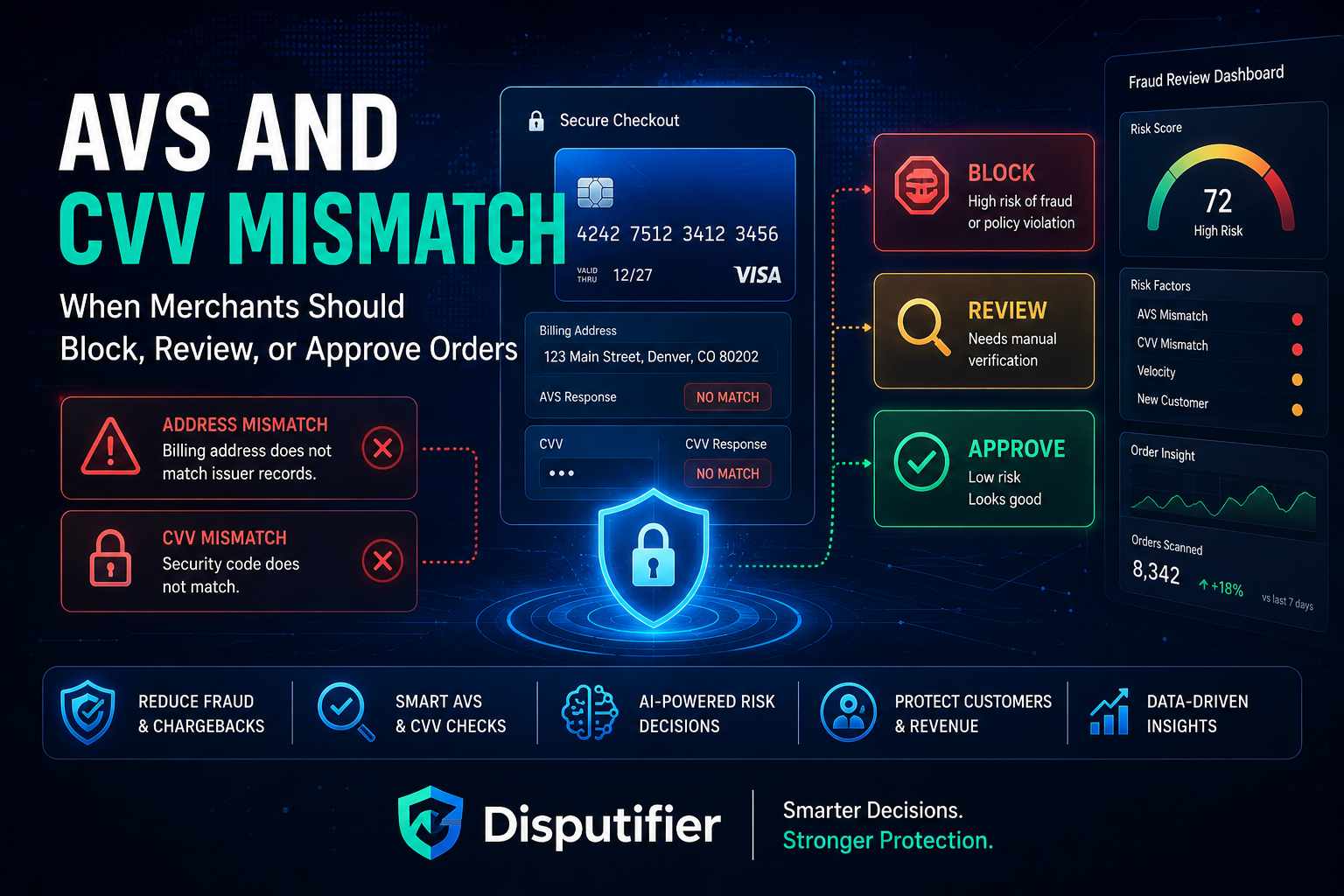
AVS CVV mismatch issues create a lot of confusion for ecommerce merchants.
A payment comes through. The order looks good at first glance. Then you notice the AVS result is weak, the CVV does not match, or both checks come back with a warning. Now you have to decide whether to block the order, review it, or approve it and hope you are not shipping fraud.
That decision matters.
If you are too strict, you kill good orders and hurt conversions. If you are too loose, you let fraud through and increase future chargeback risk. That is why AVS CVV mismatch decisions should not be treated like a simple yes-or-no rule.
They should be part of a smarter fraud screening system.
This guide breaks down what AVS and CVV mismatches actually mean, when merchants should block or review orders, when approval may still make sense, and how Disputifier helps merchants make better fraud decisions with stronger transaction context.
If you want the bigger fraud-screening foundation first, read Ecommerce Fraud Detection: How It Works and Which Signals Matter.
What is AVS?
AVS stands for Address Verification Service.
It checks whether the billing address entered by the customer matches the address on file with the card issuer. Depending on the payment system, it may compare parts of the street address, postal code, or both.
AVS helps merchants spot transactions where the billing details do not line up well enough to inspire confidence.
That makes it useful.
But it also has limits.
A mismatch does not always mean fraud. A customer can mistype their address, move recently, use a business card with different billing information, or make a formatting mistake that triggers a weak match.
That is why AVS is useful, but not decisive on its own.
What is CVV?
CVV stands for Card Verification Value.
It is the security code tied to the payment card. When the customer enters that code at checkout, the merchant can verify whether it matches the information expected by the issuer.
A CVV mismatch can be a stronger fraud signal than an AVS mismatch in some situations because it suggests the person attempting the transaction may not have the full card details.
But again, it is not perfect.
A mismatch can happen because the customer entered the code wrong, used the wrong card, or made a simple input mistake.
That is why CVV is important, but still best used with other signals.
What does AVS CVV mismatch actually tell a merchant?
An AVS CVV mismatch tells you one thing clearly:
This order deserves more attention.
It does not always mean the order is fraudulent.
It does not always mean the order should be blocked.
It means the transaction has friction that should be evaluated in context.
This is exactly where merchants go wrong. Some approve everything because they do not want to lose sales. Others decline everything because they fear fraud. Both approaches create unnecessary losses.
The better approach is risk-based decision-making.
Why AVS and CVV mismatches matter in ecommerce
In ecommerce, merchants do not get the benefit of in-person card verification.
That means small transaction signals matter more.
AVS and CVV checks help merchants reduce risk because they can catch some transactions where the buyer does not actually control the full billing or card information.
That matters for:
- stolen-card fraud
- account takeover
- card testing
- higher-risk new customer orders
- transactions likely to become fraud chargebacks later
This is why AVS CVV mismatch handling belongs inside fraud prevention, not just payments admin.
If you want the broader chargeback connection, read How to Prevent Chargeback Fraud in Ecommerce.
When merchants should block an AVS CVV mismatch order
There are cases where blocking the order is the right call.
Merchants should strongly consider blocking when the mismatch appears alongside several other high-risk signals.
Those may include:
- AVS mismatch and CVV mismatch together
- first-time customer with no order history
- unusually high order value
- risky international destination
- strange shipping urgency
- suspicious device behavior
- repeated payment attempts
- IP mismatch or proxy-like behavior
- signals that resemble card testing
In other words, the mismatch itself is not always the reason to block. The mismatch plus the rest of the pattern is.
That distinction matters.
A single mismatch may be noise. A mismatch inside a cluster of suspicious signals is a different story.
When merchants should review an AVS CVV mismatch order
Review is often the right middle ground.
Merchants should review the order when the mismatch is present, but the transaction is not clearly fraudulent.
This usually makes sense when:
- the order value is moderate
- the customer information is mostly consistent
- the product mix is normal
- the device behavior is not obviously suspicious
- the shipping and billing details are believable
- the customer is reachable
- there are no major velocity or fraud-pattern red flags
This is where operational judgment matters.
A manual review step lets the merchant check more context before deciding. For many stores, this is the difference between blocking good orders unnecessarily and letting preventable fraud through.
When merchants may still approve an AVS CVV mismatch order
Approval can still make sense if the overall transaction looks low risk.
This may happen when:
- the customer is a repeat buyer
- the account has clean order history
- the order value is normal for that customer
- the shipping address is already known
- the mismatch is minor or explainable
- device and IP behavior look normal
- there are no velocity or testing signals
In those cases, a hard decline may cost more than the fraud risk itself.
This is why strong fraud prevention is never just about one rule. It is about weighing the full context around the order.
The biggest mistake merchants make with AVS and CVV mismatches
The biggest mistake is treating every mismatch the same.
That leads to two bad outcomes.
Blocking too aggressively
This hurts real customers, lowers conversion, frustrates repeat buyers, and makes the checkout experience worse than it needs to be.
Approving too casually
This increases fraud exposure, creates future chargebacks, and weakens the fraud system.
The better approach is a rules-plus-context model.
Use AVS and CVV results as important risk signals, but combine them with other order-level signals before deciding.
What other signals merchants should check alongside AVS and CVV
This is where fraud screening becomes smarter.
An AVS CVV mismatch should be reviewed alongside:
- order value
- customer history
- BIN data
- device behavior
- IP location
- billing and shipping mismatch
- order velocity
- product category risk
- support history if available
That is exactly why merchants need a broader fraud detection system instead of relying on isolated payment flags.
If you want more on signal stacking, read What Is BIN Testing and How Merchants Can Stop It.
Why BIN data helps with AVS CVV mismatch decisions
BIN data adds useful card-level context.
A BIN can help merchants understand things like:
- issuing bank
- card type
- card region
- whether the card origin aligns with the order context
- whether the transaction fits known fraud patterns better than normal customer behavior
This matters because an AVS or CVV mismatch becomes more meaningful when the rest of the payment data also looks questionable.
That is one reason Disputifier’s free BIN checker is so useful. It helps merchants add card-level analysis to fraud review instead of relying only on surface-level mismatch signals.
For more on this, read How BIN Data Helps Detect Fraud Before It Happens.
How Disputifier helps merchants handle AVS CVV mismatch risk
Disputifier matters because AVS and CVV mismatches should not be handled in isolation.
They should be interpreted inside a wider risk workflow.
That is exactly where many merchants struggle. They can see the mismatch, but they cannot connect it fast enough to the rest of the fraud picture.
Disputifier helps solve that problem.
Disputifier helps merchants move beyond simple pass-fail logic
A lot of payment systems reduce fraud checks to blunt flags.
Disputifier helps merchants use those flags more intelligently by bringing more transaction context into the decision.
That helps merchants avoid the two worst outcomes: blocking too many good orders and approving too many bad ones.
Disputifier helps merchants combine BIN intelligence with transaction review
BIN intelligence becomes more valuable when a payment already shows friction.
Disputifier helps merchants use BIN-level information as part of broader fraud review so AVS CVV mismatch decisions become smarter and less reactive.
Disputifier helps merchants reduce fraud before it becomes chargeback pain
If bad mismatch decisions lead to fraudulent approvals, the problem often shows up later as a chargeback.
That is why AVS CVV handling belongs inside chargeback prevention as well as fraud prevention.
Disputifier helps merchants connect those two sides of the workflow.
Disputifier helps merchants improve operational consistency
One of the hardest things about fraud review is inconsistency. One team member declines too much. Another approves too much. No one has a shared framework.
Disputifier helps merchants build more consistent fraud review logic around actual risk signals instead of guesswork.
A practical AVS CVV mismatch decision framework
If you want a simple working model, use this approach.
Block the order when:
- AVS and CVV both fail
- the order is high value
- the customer is new
- device or IP behavior looks suspicious
- velocity signals are present
- the transaction resembles card testing or fraud patterns
Review the order when:
- only one check mismatches
- the rest of the transaction is mixed, not clearly bad
- the order is not obviously fraudulent but not fully clean either
- customer and shipping context leave open questions
Approve the order when:
- mismatch looks minor or explainable
- the customer has good history
- the transaction fits normal behavior
- other signals remain low risk
This is not a universal rulebook for every store, but it is a much better framework than blindly treating every mismatch the same.
Why this topic matters for ecommerce merchants
This is one of those topics merchants feel in real operations.
It is not abstract.
An AVS CVV mismatch is the kind of everyday decision that determines whether fraud prevention actually works in practice. It shapes conversion, order approval quality, fraud exposure, and future dispute pressure all at once.
That is why it fits this cluster so well.
It helps merchants build better checkout controls, stronger fraud review systems, and smarter risk decisions before bad orders become expensive losses.
Build a smarter mismatch review process
If you are dealing with AVS CVV mismatch decisions, the answer is not to approve everything or block everything.
The answer is to get smarter about context.
That means combining payment results with order behavior, customer history, BIN intelligence, fraud signals, and downstream chargeback awareness.
That is why Disputifier is so useful here.
It helps ecommerce merchants evaluate transactions with better context, improve fraud screening, reduce preventable chargebacks, and protect revenue with a stronger system.
Start by improving your order review logic and using Disputifier’s free BIN checker to add more payment-level clarity when mismatch signals appear.
Better fraud decisions do not come from more panic. They come from better context.
Frequently Asked Questions
What is an AVS CVV mismatch?
An AVS CVV mismatch happens when the billing address check, the card security code check, or both do not match what the issuer expects.
Should merchants block every AVS CVV mismatch order?
No. A mismatch should be treated as a risk signal, not an automatic decline in every case. The right decision depends on the rest of the transaction context.
Is a CVV mismatch worse than an AVS mismatch?
Sometimes. A CVV mismatch can be a stronger signal in some fraud cases, but neither check should be used alone.
When should merchants manually review a mismatch order?
Manual review makes sense when the mismatch is present but the transaction is not clearly fraudulent and other signals are mixed.
How does Disputifier help with AVS CVV mismatch decisions?
Disputifier helps merchants combine payment checks, BIN intelligence, and broader fraud signals so order review becomes smarter and more consistent.