
 All Posts


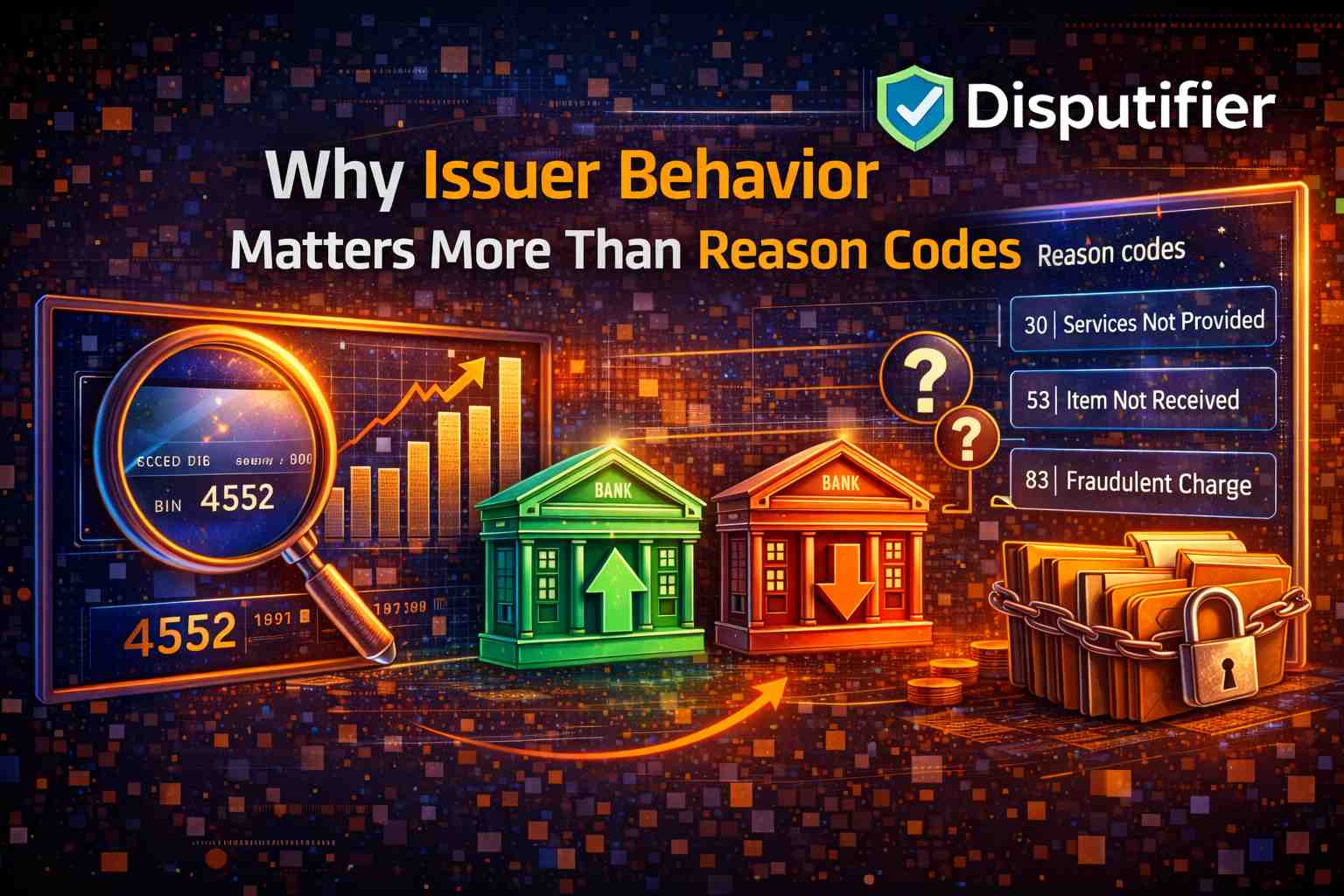
Most merchants are taught to focus on reason codes.
Reason codes feel concrete. They tell you why a customer disputed a charge. They suggest which evidence to submit. They give the illusion of control.
But reason codes do not decide outcomes.
Issuer behavior does.
Chargeback issuer behavior plays a far bigger role in dispute outcomes, merchant account risk, and long-term scalability than most ecommerce brands realize. Merchants who understand this gain a structural advantage. Merchants who don’t often fight the wrong disputes, submit the wrong evidence, and still lose.
This article explains why issuer behavior matters more than reason codes, how issuer risk analysis changes dispute strategy, and how Disputifier helps ecommerce brands adapt to issuer-driven realities.
Reason Codes Explain Disputes, Issuers Decide Them
Reason codes describe the customer’s claim.
Issuers decide whether that claim succeeds.
Two disputes with identical reason codes can have completely different outcomes depending on:
• Issuing bank policies
• Regional regulations
• Cardholder dispute history
• Issuer risk tolerance
This is why merchants often feel like chargebacks are inconsistent or unfair. They are responding to surface-level labels instead of underlying decision patterns.
Understanding this difference is foundational to improving win rates, as explored in
What ecommerce data actually improves chargeback win rates.
Why Issuer Behavior Shapes Long-Term Merchant Risk
Issuers don’t just decide individual disputes. They influence merchant risk profiles.
Payment processors monitor issuer behavior across transactions to identify merchants who generate disproportionate issuer workload. Over time, this feeds into monitoring programs, fund holds, and account restrictions.
This connection between disputes and merchant account health is explained in
How chargeback software protects merchant accounts long-term.
Ignoring issuer behavior leads to silent risk accumulation.
Not All Issuers Treat Evidence Equally
Some issuers require exhaustive documentation.
Others approve disputes with minimal review.
Some favor cardholders aggressively. Others expect merchants to meet very specific formatting or timing requirements.
Submitting the same evidence package to every issuer wastes time and lowers win rates.
This is why BIN-level insight matters more than generic dispute rules, as outlined in
BIN numbers explained: how banks, regions, and risk scores affect payouts.
Issuer Risk Analysis Beats Reason Code Optimization
Reason code optimization focuses on templates.
Issuer risk analysis focuses on probability.
High-performing merchants ask:
• Which issuers historically deny representment?
• Which issuers escalate faster?
• Which issuers require stronger proof?
• Which disputes are statistically unwinnable?
Answering these questions changes how disputes are prioritized and handled.
This predictive approach aligns with strategies discussed in
How AI chargeback analytics predict future disputes.
Why Fighting Every Dispute Is a Mistake
Merchants often assume more disputes fought equals better outcomes.
In reality, fighting low-probability disputes increases issuer friction and operational cost without improving ratios.
Issuers notice patterns of futile representment.
Over time, this behavior damages trust and increases scrutiny.
This is one reason why automation alone isn’t enough, a distinction explained in
AI vs rules-based chargeback automation: what actually scales.
Friendly Fraud Exposes Issuer Biases
Friendly fraud disputes often appear legitimate on the surface.
Issuers vary widely in how they treat these cases. Some accept merchant evidence readily. Others default to cardholder trust.
Machine learning helps detect friendly fraud patterns that issuers repeatedly approve, reducing unnecessary representment.
This strategy is covered in
How machine learning reduces friendly fraud at scale.
Issuer Behavior Impacts Chargeback Ratios
Chargeback ratios don’t only reflect merchant behavior.
They reflect issuer behavior toward that merchant.
If a merchant attracts disputes from issuers with aggressive approval policies, ratios rise faster even when fraud rates remain stable.
This makes issuer-aware prevention critical, as discussed in
How to lower your chargeback ratio below 1%.
BIN Intelligence Turns Issuer Behavior Into Strategy
BIN data connects transactions to issuing banks.
When merchants understand which BINs produce losses, they can:
• Adjust fraud rules
• Change refund timing
• Modify evidence strength
• Prevent repeat disputes
Disputifier integrates BIN intelligence directly into dispute workflows so merchants stop treating disputes as isolated events.
Merchants can explore issuer behavior themselves using the free BIN checker.
Why Disputifier Is Built Around Issuer Behavior
Disputifier does not treat chargebacks as static rule-based problems.
It evaluates issuer behavior over time and feeds those insights into:
• Dispute prioritization
• Evidence automation
• Friendly fraud detection
• Prevention workflows
This allows merchants to focus resources where outcomes are statistically favorable.
Disputifier’s approach aligns with the broader system outlined in
Ecommerce chargeback prevention tools: how to build a tech stack that actually works.
Issuer-Aware Strategy Protects Merchant Accounts
Issuers influence whether merchants enter monitoring programs.
Reducing issuer friction lowers:
• Fund holds
• Rolling reserves
• Payout delays
• Account termination risk
This relationship is explained further in
Why Stripe and Shopify hold funds and how to avoid payout delays.
Issuer-aware chargeback management protects merchant accounts long-term.
Why Advanced Merchants Stop Chasing Reason Codes
Reason codes help explain disputes.
Issuer behavior explains outcomes.
Merchants who understand this shift move faster, fight smarter, and scale with less risk.
Disputifier gives ecommerce brands the tools to operationalize issuer behavior rather than guess at it.
If you want to understand how issuers are influencing your current disputes, start by reviewing recent transactions using the free BIN checker.
FAQ: Chargeback Issuer Behavior
What is chargeback issuer behavior?
Chargeback issuer behavior refers to how issuing banks evaluate disputes, evidence, and merchants over time.
Why does issuer behavior matter more than reason codes?
Reason codes label disputes, but issuers decide outcomes based on internal policies and risk tolerance.
How can merchants analyze issuer behavior?
Through BIN data, historical outcomes, and analytics tied to dispute results.
Does Disputifier track issuer behavior?
Yes. Disputifier incorporates issuer-level intelligence into dispute prioritization and prevention.
Can issuer-aware strategies improve win rates?
Yes. Merchants who adapt strategies based on issuer behavior consistently improve outcomes.