 All Posts


You ship the order. The customer receives it. Then weeks later a notification lands in your inbox - a dispute has been filed.
If you've never dealt with a merchant dispute before, the process can feel completely opaque. The money is already gone. A bank you've never interacted with is making decisions about your transaction. And you have a narrow window to respond before your chance to fight back closes permanently.
Here's exactly how the merchant dispute process works, what you need to do at each stage, and how to build a system that handles it without eating your team alive.
What Actually Happens When a Customer Files a Dispute
Most merchants think of a chargeback as something that happens to them. In reality, it's a process that moves through several parties - and understanding each party's role changes how you respond.
When a customer decides to dispute a transaction, they contact their card issuer (the bank that issued their credit or debit card) and file a complaint. The card issuer reviews the claim - usually accepting it at face value - and reverses the transaction. That reversal pulls the funds directly from your merchant account, along with a dispute fee.
Your acquiring bank (the bank that processes your payments) then receives the chargeback notification and passes it to you. That notification includes the reason code, the amount in dispute, and your response deadline.
At this point you've already lost the money. The burden is on you to prove the transaction was legitimate and get it back.
How does a dispute work from the merchant side covers the full mechanics in detail. What most merchants don't realize until they're in the middle of one is just how little time they have to act.
The Merchant Dispute Process: Stage by Stage
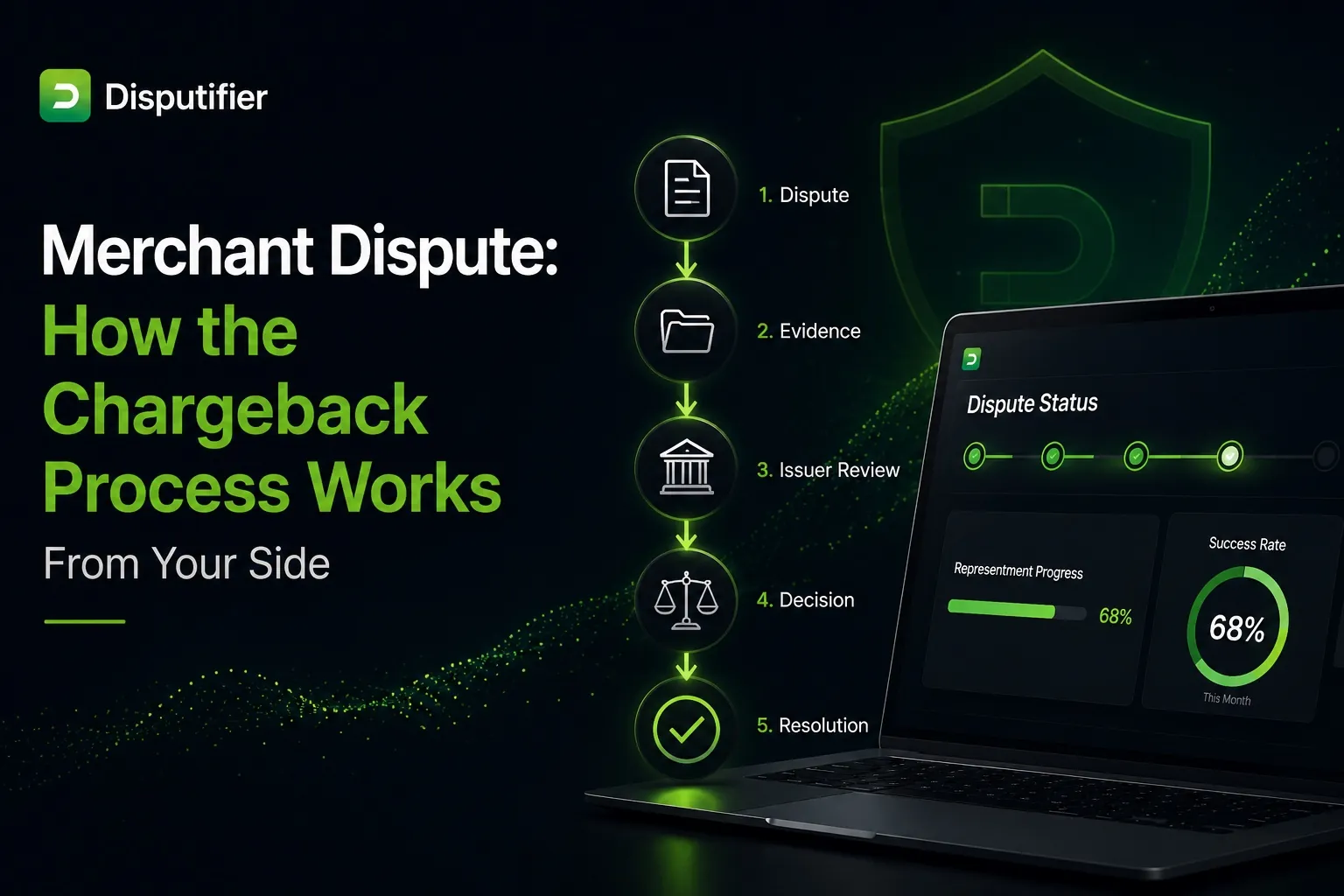
Stage 1: Chargeback Filed
The dispute starts on the customer's end. They contact their bank, make their claim, and the bank files a formal chargeback. Funds leave your account immediately - this isn't pending, it's done.
You receive a notification that a chargeback has been filed against a specific transaction. The notification includes a reason code that tells you the official reason the customer gave - unauthorized transaction, item not received, item not as described, and so on. Chargeback reason codes explained covers what each code means and how it should shape your response.
Your response clock starts now - not when you notice the notification, not when you get around to reviewing it. The deadline runs from the filing date.
Stage 2: Merchant Review and Decision
You have two options when you receive a merchant dispute notification: accept the chargeback or contest it.
Accepting means you absorb the loss without fighting it. This makes sense when the customer's claim is legitimate - a genuine delivery failure, a product that really didn't match the description, or a transaction error on your end. Fighting a legitimate dispute wastes time, costs fees, and doesn't change the outcome.
Contesting means you submit a representment - a formal response package with evidence that counters the customer's claim. This is the right move when the customer's claim is false, fraudulent, or when you have clear documentation that disproves it.
The decision about whether to contest comes down to three things: do you have evidence strong enough to win, is the transaction amount large enough to justify the effort, and is the reason code one where merchants can realistically prevail.
Stage 3: Building Your Evidence Package
If you decide to contest the merchant dispute, the quality of your evidence package determines the outcome.
What wins merchant disputes depends on the reason code. An "item not received" dispute requires delivery confirmation and tracking. An "unauthorized transaction" dispute requires proof the cardholder made the purchase - IP address data, device fingerprint, signed authorization. An "item not as described" dispute requires product documentation and communication records showing what the customer was told.
What counts as compelling evidence by reason code maps out exactly what's needed for each dispute type. Building the right evidence for the wrong reason code is one of the most common reasons merchants lose winnable disputes.
The evidence that tends to matter most across dispute types includes delivery confirmation with timestamps, customer communication records showing acknowledgment of the purchase, proof of digital access or product download after the claimed non-delivery date, and authorization documentation from checkout.
Customer communication proof that actually wins disputes covers how to use communication records effectively - this is often the deciding factor between a won and lost dispute.
Stage 4: Submitting the Representment
Once your evidence is assembled, you submit it through your acquiring bank or payment processor. The submission goes to the issuing bank for review.
The deadline is non-negotiable. Visa gives merchants approximately 30 days, Mastercard around 45, and American Express as few as 20. Miss the deadline and you lose - automatically, regardless of your evidence. How long do chargebacks take by card network breaks down the exact timelines so you know what you're working with on each dispute.
Stage 5: Issuer Decision
The issuing bank reviews your evidence and makes a decision. If they accept your representment, the dispute is resolved in your favor - the funds are returned and the process ends.
If they reject your evidence and maintain the chargeback, they file a pre-arbitration case. At that point you face another decision: accept the outcome or escalate to formal card network arbitration.
What is pre-arbitration? explains exactly what this stage looks like and when it makes sense to escalate versus absorb the loss. The short answer: arbitration comes with significant fees for both parties, so it only makes financial sense when the disputed amount exceeds the cost of fighting.
What Merchants Get Wrong About the Dispute Process
Waiting too long to act. The dispute notification arrives. It gets flagged for review. Someone gets around to it a week later. By then, a meaningful portion of the response window is already gone. Every day of delay is a day less to build a strong evidence package.
Submitting incomplete evidence. A chargeback response that includes delivery confirmation but not authorization documentation, or communication records but not proof of product access, leaves gaps the issuing bank uses to maintain the dispute. Complete packages win more often than partial ones.
Not responding at all. Some merchants don't respond to merchant disputes they believe are fraudulent because the amount feels too small to bother with. Every unanswered dispute counts against your chargeback ratio - and ratios that climb too high put your merchant account at risk. What happens if a merchant doesn't respond to a chargeback lays out the full consequences. Responding to every dispute - even small ones - is the right policy.
Treating each dispute as a one-off event. Merchants who manage disputes reactively lose more of them and miss the patterns that would reduce future dispute volume. Root cause analysis - understanding why disputes are happening, not just responding to them individually - is what separates merchants with low chargeback ratios from those in chronic trouble.
How to Strengthen Your Position Before Disputes Arrive
The merchants who win the most disputes are the ones who set themselves up to win before a dispute is ever filed.
Document every transaction at fulfillment. Delivery confirmation, tracking numbers, customer communication, proof of digital access - collect it at the time of fulfillment, not when a dispute arrives. How to prevent chargebacks: a practical guide covers the full prevention framework, but documentation discipline is one of the highest-impact pieces.
Catch fraud before it ships. Many merchant disputes stem from fraudulent transactions that should have been flagged at checkout. Disputifier's free BIN checker validates card data at the transaction level - surfacing fraud signals before an order ships and a dispute becomes inevitable 60 to 90 days later.
Use chargeback alerts. Alert networks like Ethoca and Verifi give merchants a window to resolve potential disputes before they're formally filed. A resolved alert never becomes a merchant dispute - and never hits your chargeback ratio. Setting up chargeback alerts walks through how to implement this layer.
How Disputifier Automates the Merchant Dispute Process
Disputifier is ecommerce fraud prevention and chargeback management software built specifically for online merchants. It handles every stage of the merchant dispute process automatically - detection, evidence building, response submission, and deadline management - without requiring manual effort from your team.
Instant dispute detection. The moment a merchant dispute is filed, Disputifier detects it through direct processor integration. Not hours later through a delayed email. Not days later when someone checks the inbox. Immediately - so the full response window is available.
Automated evidence building. Disputifier pulls order records, delivery confirmation, customer communication, and authorization data from your store automatically and assembles a complete evidence package tailored to the specific reason code. The right evidence for the right dispute, built without manual research.
Deadline management across all networks. Disputifier tracks response windows for Visa, Mastercard, American Express, and Discover simultaneously - applying the correct timeline rules for each dispute and triggering action before windows close. Merchants with multiple disputes across multiple networks don't have to track different deadline rules manually.
Pre-arbitration management. When a dispute escalates beyond first-stage representment, Disputifier detects the escalation and manages the pre-arbitration response window too. No stage of the process falls through the cracks.
Chargeback alert integration. Disputifier connects to Ethoca and Verifi alert networks automatically - giving merchants the pre-dispute window to resolve potential chargebacks as refunds before they become formal merchant disputes. Every alert resolved this way is a dispute that never hits your ratio.
Machine learning that improves over time. Disputifier's models learn from your specific dispute outcomes - refining evidence packages, improving response accuracy, and identifying the fraud patterns that generate merchant disputes on your store. The longer you run the platform, the better it performs.
Root cause analytics. Disputifier surfaces your dispute patterns by reason code, product category, and customer segment - so you can understand what's driving merchant disputes and make the operational changes that reduce future volume.
For Shopify merchants, Disputifier integrates directly with your store - pulling all the data it needs automatically so the entire merchant dispute workflow runs without manual oversight.
Stop managing merchant disputes one at a time and start running a system that handles all of them. Get started with Disputifier today.
Frequently Asked Questions
What is a merchant dispute?
A merchant dispute is a chargeback - a transaction reversal initiated by a customer through their card issuer. The customer claims the charge was unauthorized, the product wasn't received, or the item wasn't as described. The bank reverses the funds from the merchant's account, and the merchant has a limited window to contest the claim with evidence.
How does a merchant dispute a chargeback?
By submitting a representment - a formal response package containing evidence that disproves the customer's claim. The evidence required varies by reason code. Merchants submit through their acquiring bank or payment processor within the response deadline.
What happens if a merchant loses a dispute?
The chargeback stands, the funds stay reversed, and the merchant pays a dispute fee. The chargeback also counts against the merchant's chargeback ratio - which affects processor standing regardless of individual dispute outcomes.
Can a merchant win a dispute against a customer?
Yes. Merchants with strong, complete evidence packages win a significant portion of contested disputes. The win rate depends on the reason code, the quality of evidence, and whether the response is submitted before the deadline.
How long does a merchant have to respond to a dispute?
Response windows vary by card network: approximately 30 days for Visa and Discover, 45 days for Mastercard, and as few as 20 days for American Express. These windows run from the chargeback filing date.
What evidence do merchants need to win a dispute?
Delivery confirmation, customer communication records, authorization documentation, proof of product access for digital goods, and IP or device data from checkout. The specific evidence required depends on the reason code - what counts as compelling evidence by reason code covers each type.
What is the difference between a merchant dispute and a refund?
A refund is merchant-initiated - you choose to return the funds. A merchant dispute is customer-initiated through their bank - the funds are taken without your agreement and you have to fight to get them back. Chargeback vs refund covers why that difference matters significantly for your business.
How does Disputifier help with merchant disputes?
Disputifier detects merchant disputes in real time, builds automated evidence packages tailored to the specific reason code, tracks response deadlines across all card networks, and submits responses automatically - covering every stage of the process without manual effort.
Handle Every Merchant Dispute With a System That Doesn't Miss Deadlines
The merchant dispute process is stacked against you by default. Funds leave your account immediately. The burden of proof sits with you. Deadlines are short and unforgiving. And the volume compounds quickly when disputes start stacking up.
Disputifier gives ecommerce merchants a system that handles every stage automatically - detection, evidence, deadlines, and escalation - so merchant disputes get responded to consistently whether your team is paying attention or not. Get started with Disputifier today.