
 All Posts


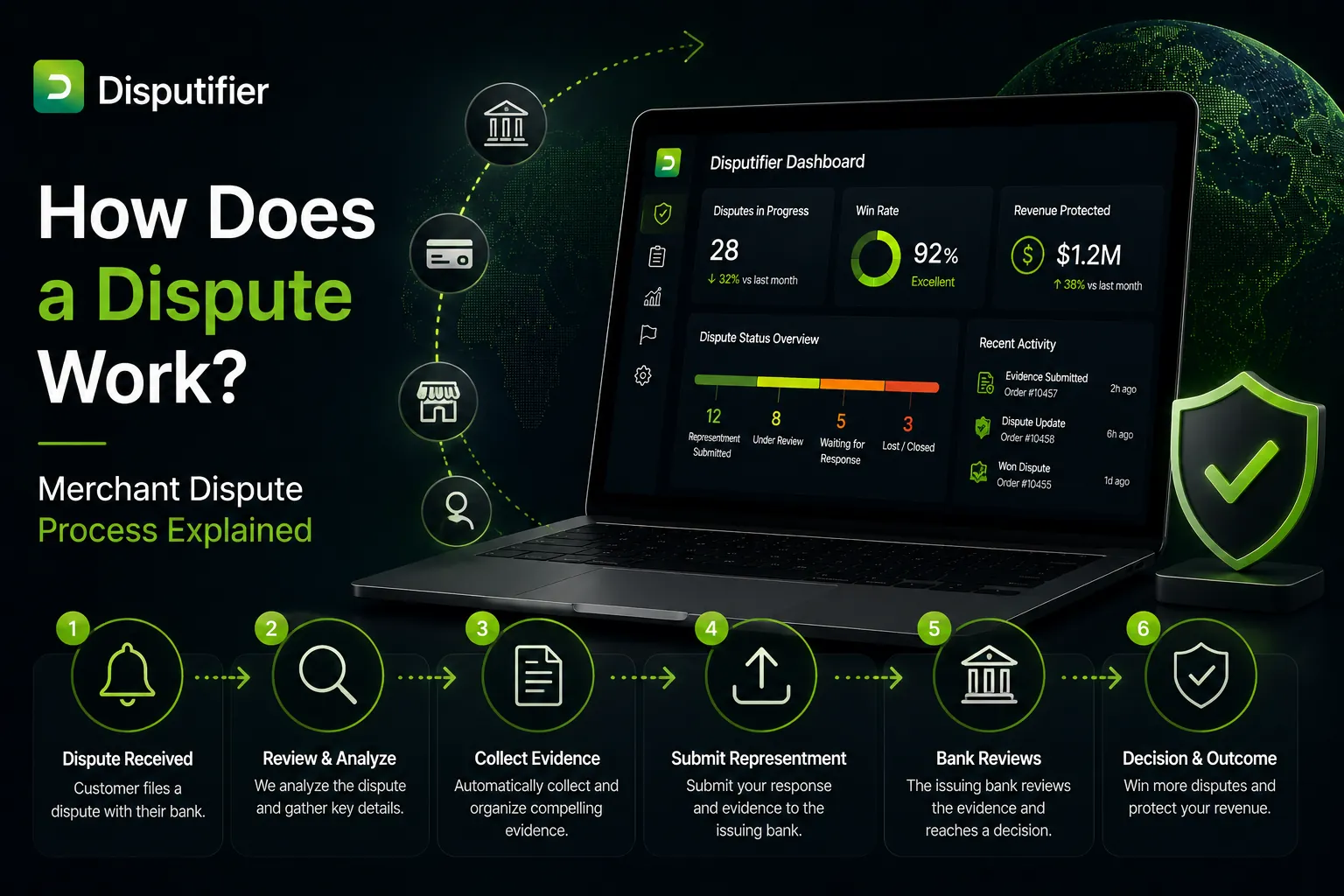
If you run an online store, understanding how a dispute works is essential.
A lot of merchants only learn the dispute process after money has already been pulled from their account. By then, the pressure is high, deadlines are short, and the process feels more complicated than it should.
That is a mistake you can avoid.
The merchant dispute process follows a clear structure. Once you understand the stages, you can respond faster, organize better evidence, reduce unnecessary losses, and build stronger systems to prevent disputes in the first place.
This guide explains how the dispute process works, what happens at each stage, why disputes escalate into chargebacks, and how ecommerce merchants can protect revenue with smarter workflows.
If you want the broader foundation first, start with What Is a Chargeback? The Complete Ecommerce Guide.
What is a dispute?
A dispute happens when a cardholder challenges a transaction.
The customer contacts their bank or card issuer and says there is a problem with the charge. That problem may involve fraud, a product issue, a billing mistake, a missing refund, or a service complaint.
Not every dispute immediately becomes a chargeback, but many do if the issue is not resolved early.
That is why merchants need to understand the full dispute process, not just the chargeback stage.
For a full breakdown of the terminology, read Chargeback vs Dispute: Understanding the Difference to Protect Your Store.
Why customers file disputes
Customers file disputes for several reasons.
The most common include:
- they believe the transaction was unauthorized
- they did not receive the item
- they say the product was not as described
- they were charged twice
- they expected a refund that never arrived
- they canceled a subscription but were still billed
- they do not recognize the charge on their statement
- they skip support and go straight to the bank
Some of these disputes are legitimate.
Some are caused by confusion.
Some are caused by friendly fraud.
Some are caused by real fraud or internal merchant errors.
The exact reason matters because it determines how the merchant should respond.
How does a dispute work?
The merchant dispute process usually follows these steps.
1. The customer questions the transaction
The process starts when the cardholder notices a charge they do not want, do not understand, or believe is invalid.
They contact their bank instead of the merchant.
This is the moment merchants lose control of a simple customer-service issue and enter the formal dispute process.
That is why good customer communication and easy refund resolution matter so much. If customers cannot resolve problems directly, they are more likely to escalate them to the bank.
2. The issuer reviews the complaint
The customer’s bank reviews the cardholder’s claim and decides how to classify it.
The bank may assign a reason code based on the nature of the complaint.
That reason code is critical because it defines the dispute category and shapes the type of evidence the merchant will need later.
For a deeper breakdown, read Chargeback Reason Codes Explained: Full List for Merchants.
3. The transaction may be reversed
In many cases, the issuer provisionally credits the cardholder and reverses the disputed funds from the merchant.
This is the point where merchants feel the financial impact.
The order revenue is pulled back, even though the case may not be final yet.
If the merchant does nothing from here, the dispute usually stands.
4. The merchant gets notified
The payment processor, acquiring bank, or payments platform notifies the merchant that a dispute or chargeback has been opened.
This notice usually includes:
- the transaction amount
- the reason code
- the dispute deadline
- any basic claim details
- the submission method for evidence
This stage is where process quality matters. Merchants need to know exactly who on the team handles disputes, where records are stored, and how evidence gets assembled.
5. The merchant decides whether to fight the dispute
Not every case should be contested.
Sometimes the customer is clearly right. Sometimes the amount is too small to justify the labor. Sometimes the merchant’s records are weak. In other cases, the dispute is absolutely worth fighting.
That decision should depend on:
- the reason code
- the value of the order
- the quality of available evidence
- whether the transaction was valid
- whether the dispute reflects fraud, friendly fraud, or internal merchant failure
If the transaction was legitimate and the evidence is strong, the merchant should usually respond.
6. The merchant submits evidence
This is the core response phase.
The merchant provides documents and data that support the original transaction. The exact evidence depends on the type of dispute.
That may include:
- order confirmation
- AVS and CVV match results
- IP address data
- device information
- billing and shipping records
- tracking and delivery confirmation
- customer emails or chat logs
- refund policy acceptance
- subscription terms
- proof of digital usage or access
The strongest evidence is always relevant evidence.
If you want a deeper explanation of the response phase, read What Is Representment? Chargeback Representment Explained for Merchants.
7. The issuer reviews the merchant’s response
Once the merchant submits evidence, the issuer reviews the case.
The bank decides whether the merchant proved that the transaction was valid or whether the cardholder’s claim should stand.
If the merchant wins, the funds may be returned.
If the merchant loses, the chargeback remains in place.
8. The dispute may escalate further
Some cases do not end after the first review.
Depending on the network and case details, the dispute may move into later stages such as pre-arbitration.
That is why merchants need to understand that the dispute process is not always one email and one decision. Some cases become more complicated, more expensive, and more time-sensitive as they escalate.
What evidence matters most in the dispute process?
This depends on the claim.
That is why merchants lose so many disputes. They send generic evidence instead of relevant evidence.
Here is how it usually breaks down.
Fraud claims
The merchant may need:
- AVS and CVV match data
- IP and device information
- billing and shipping consistency
- account history
- customer usage records
- transaction behavior patterns
Item not received claims
The merchant may need:
- carrier tracking
- delivery confirmation
- signature confirmation
- shipping updates
- customer communication
Product not as described claims
The merchant may need:
- product page screenshots
- clear item descriptions
- return policy acceptance
- customer support communication
- proof of product condition or delivery
Billing or refund disputes
The merchant may need:
- invoice records
- refund logs
- cancellation records
- subscription terms
- communication timestamps
If you want the full evidence framework, read What Counts as Compelling Evidence by Reason Code: A Merchant’s Template Library.
What happens if a merchant does not respond?
If a merchant does not respond, they usually lose automatically.
That means:
- the funds stay reversed
- the chargeback counts against the merchant
- the business loses any chance to recover the revenue
- the dispute contributes to chargeback ratio pressure
This is one of the most damaging failures in the entire process because it is often preventable.
In many cases, merchants do not lose because the customer was right. They lose because the internal process was disorganized.
For a deeper look at the consequences, read What Happens If a Merchant Doesn’t Respond to a Chargeback? Consequences and Fixes.
Why disputes are so hard for ecommerce merchants
The dispute process is harder in ecommerce because online transactions already carry more ambiguity.
There is no face-to-face verification. Merchants deal with shipping timelines, fulfillment issues, cross-border orders, subscriptions, friendly fraud, and customer-service gaps.
That means disputes can come from several different sources at once:
- criminal fraud
- friendly fraud
- customer confusion
- fulfillment problems
- weak communication
- policy friction
- internal billing errors
That is why a strong ecommerce dispute process has to connect fraud prevention, customer communication, order fulfillment, and evidence readiness.
Why Disputifier matters in the merchant dispute process
Disputifier matters because the dispute process rewards merchants who are organized and punishes merchants who are reactive.
Most stores do not lose disputes because they lack good intentions. They lose because the process is fragmented.
Order data sits in one place.
Support messages sit somewhere else.
Shipping proof is buried in a carrier portal.
Fraud signals live in a separate system.
The person responding is scrambling against a deadline.
That is exactly the kind of mess Disputifier helps solve.
Disputifier helps merchants respond faster
Disputes move on deadlines. The faster a merchant can identify the reason code, gather evidence, and decide whether to fight the case, the better.
Disputifier helps merchants centralize the information needed to respond quickly.
Disputifier helps merchants improve evidence quality
A weak dispute response is often an evidence problem.
Disputifier helps merchants organize the records that matter most, so responses become more relevant and more consistent.
That improves recovery potential and reduces the number of preventable losses.
Disputifier helps merchants connect fraud and disputes
Many merchants treat fraud prevention and dispute management as separate problems.
They are not.
Disputifier helps merchants connect transaction risk, customer behavior, and dispute outcomes so they can improve decisions before and after a chargeback happens.
That is especially useful for spotting patterns in friendly fraud, order abuse, and recurring risk.
Disputifier helps merchants protect merchant accounts
The dispute process is not just about one case. It affects long-term account health.
Too many losses can raise your chargeback ratio, increase processor scrutiny, and create payout risk.
Disputifier helps merchants strengthen the entire workflow so the business becomes more stable over time.
You can even improve payment-level risk analysis earlier in the flow by using Disputifier’s free BIN checker to understand card-related context before or after a transaction becomes problematic.
How merchants should improve their dispute process
If you want a better merchant dispute process, focus on these fundamentals.
Understand the dispute category first
Do not respond blindly. Start with the reason code and the actual claim.
Organize records before disputes happen
The best time to prepare evidence is before you need it.
Keep support and fulfillment records clean
A messy communication trail weakens your position.
Make direct resolution easier for customers
The easier it is to contact you, the fewer problems escalate to the bank.
Review patterns, not just single cases
If the same type of dispute keeps appearing, the real issue is operational.
Use better tools
Manual dispute handling works for a while. Then it breaks.
If you want the full response framework, read How to Win a Chargeback: Step-by-Step for Ecommerce.
Build a smarter dispute process
If you run an online store, understanding how a dispute works gives you a major advantage.
It helps you respond faster, avoid preventable losses, and build better systems before chargebacks turn into a bigger business problem.
That is exactly why this topic matters in the chargeback cluster. It brings merchants in early, before they are searching for dispute software, and helps them understand the operational logic behind the whole process.
Disputifier helps merchants take the next step.
It supports stronger fraud prevention, better evidence organization, faster dispute workflows, and better long-term protection for ecommerce businesses.
The merchants who handle disputes best are not guessing. They understand the process and they build for it.
Frequently Asked Questions
How does a dispute work for a merchant?
A dispute starts when a customer challenges a transaction through their bank. The bank reviews the claim, may reverse the funds, and gives the merchant a chance to respond with evidence.
Is every dispute a chargeback?
Not always. A dispute is the broader challenge to a transaction. A chargeback is one formal outcome or stage within that dispute process.
What evidence does a merchant need in a dispute?
That depends on the reason code, but common evidence includes order confirmation, delivery proof, AVS and CVV data, customer communication, refund records, and product details.
What happens if a merchant ignores a dispute?
If a merchant ignores a dispute, they usually lose automatically and the reversed funds are not recovered.
How can ecommerce merchants improve dispute outcomes?
They can improve outcomes by understanding reason codes, organizing evidence early, keeping strong customer records, and using tools like Disputifier to streamline the process.