 All Posts


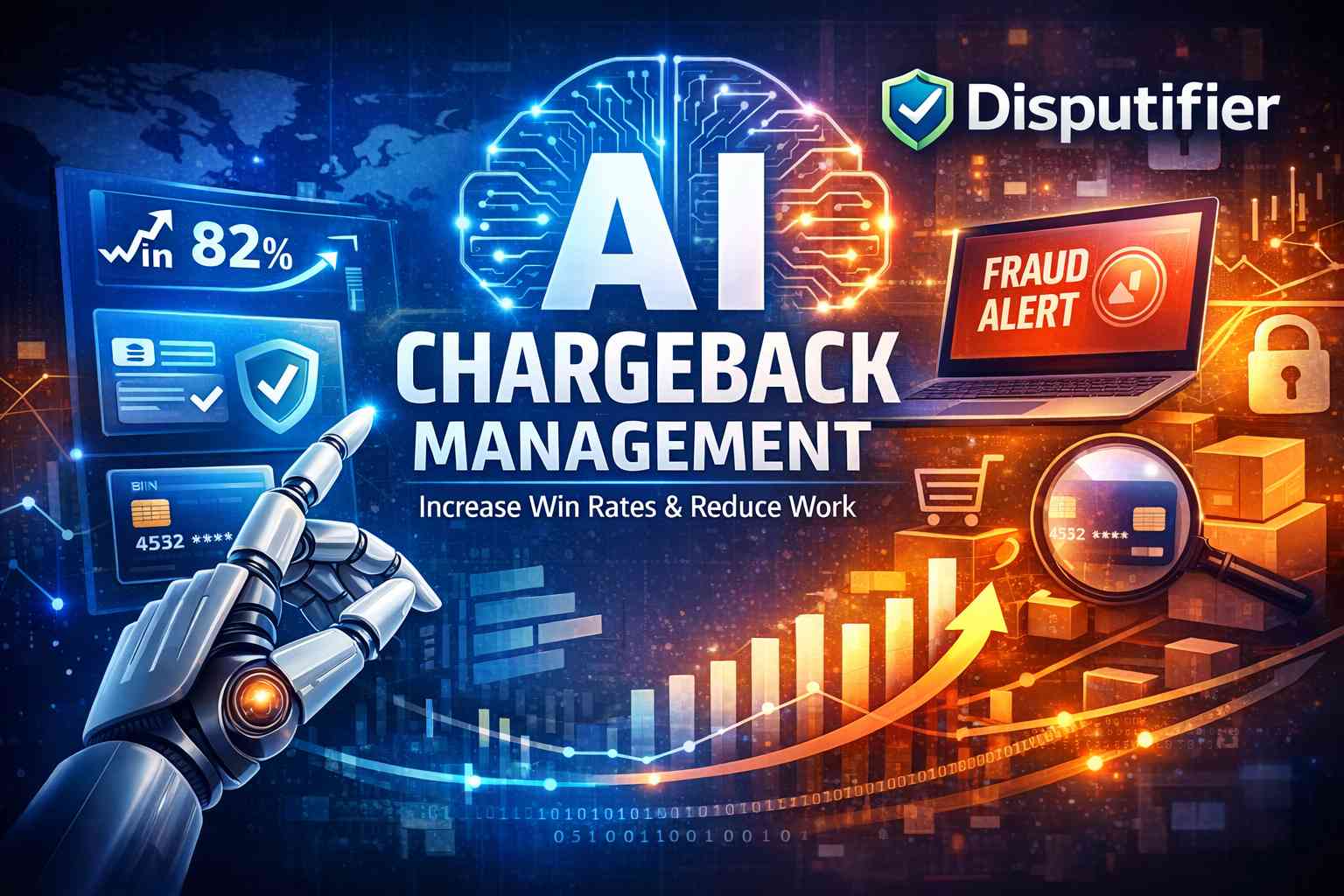
AI chargeback management is quickly becoming a requirement for serious ecommerce brands, not a future nice-to-have.
As order volume scales and payment ecosystems get stricter, manual dispute handling fails. Deadlines shrink. Fraud evolves faster than static rules. Payment processors judge merchants on ratios, not context. AI chargeback management fills that gap by turning dispute handling into a predictive, automated system rather than a reactive chore.
This article explains what AI chargeback management actually does, how machine learning increases win rates, and why ecommerce brands are moving toward intelligent dispute systems like Disputifier.
What AI Chargeback Management Actually Means
AI chargeback management uses machine learning models to analyze disputes, transactions, customer behavior, issuer data, and historical outcomes to automate decisions across the entire dispute lifecycle.
This goes far beyond basic automation. Rule-based tools can submit evidence faster, but they don’t learn. AI dispute management systems improve continuously by analyzing what works, what fails, and why.
At a practical level, AI chargeback management focuses on five functions:
• Predicting win probability before fighting a dispute
• Automatically building evidence packages by reason code
• Detecting fraud patterns using BIN data and transaction history
• Prioritizing which disputes deserve attention
• Feeding dispute analytics back into prevention strategies
This approach aligns closely with how modern ecommerce fraud stacks work, as outlined in The Role of Ecommerce AI in Chargeback Prevention.
Predicting Which Chargebacks Are Worth Fighting
One of the most expensive mistakes merchants make is fighting every chargeback the same way.
AI chargeback management systems score disputes based on historical outcomes, issuer behavior, reason codes, transaction attributes, and merchant-specific performance data. This creates a win probability for each case.
Instead of wasting time on low-probability disputes, brands can focus resources where recovery likelihood is highest. That alone increases net recovery and reduces operational drag.
Disputifier applies this logic across dispute pipelines, helping merchants prioritize intelligently rather than emotionally. This ties directly into the data behind how often merchants actually win chargebacks and how to improve those odds.
Automated Evidence Assembly by Reason Code
Manual evidence building is one of the biggest bottlenecks in dispute management.
AI dispute management systems automate evidence assembly by mapping chargeback reason codes to required documentation and pulling verified data directly from connected systems.
Instead of uploading random screenshots, AI chargeback automation builds structured, network-compliant evidence packages that include:
• Proof of delivery and carrier confirmation
• AVS and CVV match data
• Device and IP intelligence
• Customer communication records
• Policy acceptance and checkout confirmations
This directly supports network definitions of compelling evidence, which are broken down in What Counts as Compelling Evidence by Reason Code.
Automated evidence reduces missed deadlines, improves submission quality, and removes inconsistency across disputes.
Detecting Fraud Patterns Using BIN Intelligence and History
AI chargeback management doesn’t start at the dispute stage. It starts before the transaction settles.
Machine learning models analyze BIN data, issuing banks, regions, historical fraud rates, and merchant-specific patterns to identify high-risk transactions. BIN intelligence adds issuer-level context that traditional fraud tools often miss.
Disputifier integrates BIN analysis directly into its AI dispute engine, allowing fraud signals to inform both prevention and recovery decisions. This capability is explored in depth in How Disputifier Combines Free BIN Checker With AI for Better Fraud Protection.
Merchants can also explore this data firsthand using Disputifier’s free BIN checker, which shows how issuing banks and regions impact risk and dispute behavior.
Prioritizing Disputes Automatically at Scale
As ecommerce volume grows, human prioritization breaks down.
AI chargeback automation assigns urgency and value to disputes based on deadlines, recovery likelihood, transaction value, and account risk exposure. High-impact disputes surface automatically, while low-value cases receive proportionate treatment.
This protects merchants from silent losses caused by missed responses, escalations, and pre-arbitration deadlines. It also mirrors the real-world workflows described in Chargeback Automation in Practice.
For Shopify, PayPal, and Stripe merchants processing high order volume, this level of automation is critical to preventing payout delays and rolling reserves.
Turning Dispute Data Into Prevention Strategy
The most overlooked benefit of AI dispute management is feedback.
Every dispute outcome feeds the system. Over time, AI identifies patterns across products, fulfillment methods, regions, customer behavior, and payment providers. These insights drive changes upstream.
Disputifier surfaces these insights through analytics designed to reduce future disputes, not just recover funds. This feedback loop plays a central role in chargeback analytics for reducing fund holds and payout delays.
Brands that treat chargebacks as a data problem outperform those that treat them as isolated incidents.
Why Disputifier Is Built for AI Chargeback Management
Disputifier is a dispute management and chargeback prevention platform built specifically for ecommerce brands that need automation without losing control.
Instead of relying on static rules, Disputifier combines AI chargeback management, BIN intelligence, real-time alerts, and analytics into a unified system.
Core capabilities include:
• AI-powered dispute scoring and prioritization
• Automated evidence generation aligned to network rules
• BIN-based fraud detection and issuer intelligence
• Real-time chargeback alerts to stop disputes before filing
• Analytics that identify root causes and prevention opportunities
Disputifier integrates with major ecommerce platforms and payment processors, making it suitable for high-volume and international merchants. It also supports workflows specific to Shopify and PayPal sellers, as detailed in Shopify chargeback and dispute management automation and PayPal chargeback automation.
AI Chargeback Management vs Manual Workflows
Manual workflows don’t scale.
Spreadsheets fail. Reminders get missed. Evidence quality varies. Human judgment introduces inconsistency and burnout. AI dispute management eliminates these risks by standardizing decisions and improving outcomes over time.
This transition point is covered in Dispute Management Software vs Manual Workflows.
For most growing ecommerce brands, the need to upgrade arrives earlier than expected.
Protecting Merchant Accounts and Payouts With AI
Chargebacks impact more than refunds. They affect processor trust, payout timing, reserve requirements, and account stability.
AI chargeback management helps merchants stay below critical thresholds by reducing dispute volume and improving win rates. This directly influences whether funds are held or released.
If payout delays are already an issue, AI automation becomes a defensive necessity. This relationship is explained in Why Stripe and Shopify Hold Funds and How to Avoid Payout Delays.
Build a Smarter Chargeback System
Chargebacks won’t disappear. Networks won’t relax rules. Fraud will keep evolving.
AI chargeback management gives ecommerce brands leverage. It replaces guesswork with probability, manual labor with automation, and reactive workflows with predictive systems.
Disputifier provides the infrastructure ecommerce businesses need to recover revenue, prevent fraud earlier, and scale without operational chaos.
Explore how Disputifier fits into your chargeback stack, or start by testing the free BIN checker to see how issuer data affects fraud and dispute outcomes.
FAQ: AI Chargeback Management
What is AI chargeback management?
AI chargeback management uses machine learning to automate dispute handling, predict outcomes, assemble evidence, and reduce future chargebacks through analytics and prevention feedback.
How does AI increase chargeback win rates?
AI increases win rates by prioritizing high-probability disputes, submitting stronger evidence, and aligning responses with card network requirements.
Is AI chargeback automation better than manual workflows?
For high-volume ecommerce brands, yes. Manual workflows don’t scale reliably and often lead to missed deadlines and inconsistent results.
Can AI help prevent chargebacks before they happen?
Yes. AI analyzes transaction patterns, BIN data, and customer behavior to flag risky orders and reduce friendly fraud.
Does Disputifier replace fraud prevention tools?
Disputifier complements fraud tools by focusing on dispute recovery, issuer intelligence, and prevention feedback loops that traditional tools don’t cover.